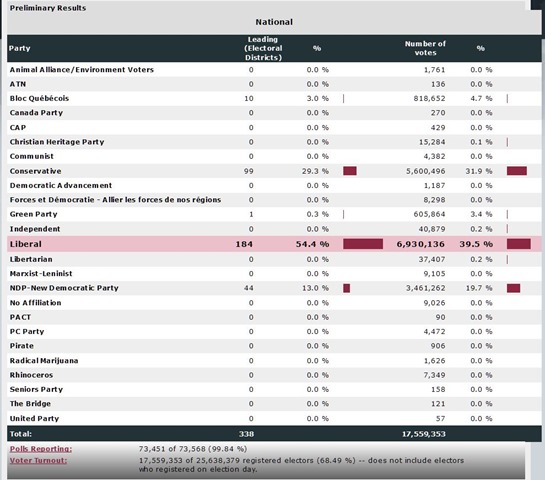
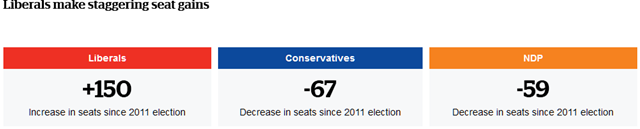
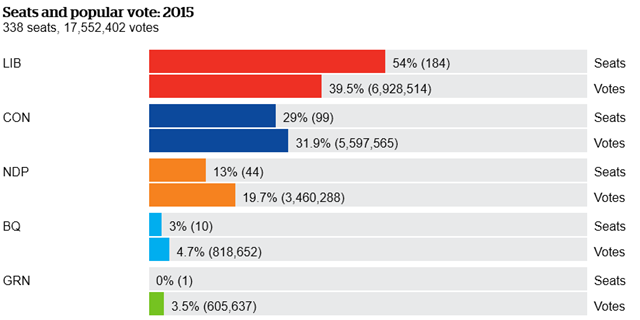
With thanks to: http://www.cbc.ca/news2/interactives/results-2015/; Elections Canada

Category Archives: Federal Conservatives
Federal programs and research facilities that have been shut down or had their funding reduced
THE FIFTH ESTATE Friday January 10, 2014 in Science and Technology
Hundreds of federal programs and world renowned research facilities have been shut down or had their funding reduced by the federal government. This list was compiled by the Canadian Association of University Teachers and the Professional Institute of the Public Service of Canada. If you are a federal government scientist or researcher and your program, project, or research facility has been affected by the cuts we would like to hear from you, please comment below or send us an email at fifth@cbc.ca
- Environmental Emergency Response Program
- Urban Wastewater Program
- Canadian Foundation for Climate and Atmospheric Sciences
- Smokestacks Emissions Monitoring Team
- Hazardous Materials Information Review Commission
- National Roundtable on the Environment and the Economy
- Canadian Environmental Assessment Agency, Winnipeg Office
- Municipal Water and Wastewater Survey
- Environmental Protection Operations
- Compliance Promotion Program
- Action Plan on Clean Water
- Polar Environment Atmospheric Research Laboratory (PEARL) (PEARL lost its $1.5 million annual budget when the government stopped funding the Canadian Foundation for Climate and Atmospheric Science (CFCAS) . In May 2013, the federal government announced the facility would get a $ 1 million a year grant for the next five years. But according to Professor Tom Duck, of Dalhousie University, with the loss of CFCAS, atmospheric and climate research will be funded at less than 70 per cent of the level it was funded at in 2006.)
- Sustainable Water Management Division
- Environmental Effects Monitoring Program
- Federal Contaminated Sites Action Plan
- Chemicals Management Plan
- Canadian Centre for Inland Waters
- Clean Air Agenda
- Air Quality Health Index
- Species at Risk Program
- Weather and Environmental Services
- Substance and Waste Management
- Ocean Contaminants & Marine Toxicology Program
- Experimental Lakes Area (Under the Bill-38 the ELA was shut down. As of January 2014, the International Institute for Sustainable Development and the Ontario government are working out an agreement with the federal government to take over the facility.)
- DFO Marine Science Libraries
- Centre for Offshore Oil & Gas Energy Research
- Kitsilano Coast Guard Station
- St. Johns Marine Traffic Centre
- St. Anthony’s Marine Traffic Centre
- Conservation and Protection Office
- Conservation and Protection Office (L’anse au Loup, NL)
- Conservation and Protection Office (Trepassey, NL)
- Conservation and Protection Office (Rigolet, NL)
- Conservation and Protection Office (Burgeo, NL)
- Conservation and Protection Office (Arnold’s Cove, NL)
- Conservation and Protection Office (Baddeck, NS)
- Conservation and Protection Office (Canso, NS)
- Conservation and Protection Office (Sheet Harbour, NS)
- Conservation and Protection Office (Woodstock, NB)
- Conservation and Protection Office (Port Hood, NS)
- Conservation and Protection Office (Wallace, NS)
- Conservation and Protection Office (Kedgwick, NB)
- Conservation and Protection Office (Montague, PEI)
- Conservation and Protection Office (Inuvik, NT)
- Conservation and Protection Office (Rankin Inlet, NU)
- Conservation and Protection Office (Clearwater, BC)
- Conservation and Protection Office (Comox, BC)
- Conservation and Protection Office (Hazelton, BC)
- Conservation and Protection Office (Quesnel, BC)
- Conservation and Protection Office (Pender Harbour, BC)
- Atlantic Lobster Sustainability Measures Program
- Species-at-Risk Program
- Habitat Management Program
- DFO Institute of Ocean Sciences (Sidney, BC)
- Freshwater Institute – Winnipeg
- Oil Spill Counter-Measures Team
- Maurice-Lamontagne Institute’s French language library
- Canadian Coast Guard Management
- Water Pollution Research Lab (Sidney, BC)
- Water Pollution Research Lab (Winnipeg, MB)
- Water Pollution Research Lab (Burlington, ON)
- Water Pollution Research Lab (Mont-Joli, QC)
- Water Pollution Research Lab (Moncton, NB)
- Water Pollution Research Lab (Dartmouth, NS)
- St. Andrew Biological Station
- Canadian Scientific Submersible Facility
- Ice Information Partnership
- Motor Vehicle Fleet
- Inshore Rescue Boat Program
- Species at Risk Atlantic Salmon Production Facilities
- Northwest Atlantic Fisheries Organization
- At-Sean Observer Programs
- Financial Management Services
- Pacific Forestry Centre, Satellite Office (Prince George, BC)
- Canadian Centre for Remote Sensing
- Pulp and Paper Green Transformation Program
- Isotopes Supply Initiative
- Clean Energy Fund
- Sustainable Development Technology Canada – Next Generation Biofuels Fund
- Program of Energy Research and Development
- Pacific Forestry Centre
- Astronomy Interpretation Centre – Centre of the Universe
- MRI research, Institute Biodiagnostics
- Polar Continental Shelf Progam
- Canadian Neutron Beam Centre
- Aquatic Ecotoxicology, Aquatic and Crop Resource Development
- Molecular Biochemistry Laboratory, Aquatic and Crop Resource Development
- Plant Metabolism Research, Aquatic and Crop Resource Development
- Human Health Therapeutics research program
- Automotive and Surface Transportation program
- Magnetic Resonance Imaging Research
- Environmental Risks to Health program
- Substance Use and Abuse program
- First Nations and Inuit Primary Health Care program
- Health Infrastructure Support for First Nations and Inuit program
- Interim Federal Health Program
- Prairie Farm Rehabilitation Administration
- Environmental Knowledge, Technology, Information, and Measurement program
- Science, Innovation and Adoption program
- Rural and Co-operatives Development program
- Farm Debt Mediation Service
- Centre for Plant Health (Sidney, BC)
- National Aboriginal Health Organization
- First Nations Statistical Institute
- Cultural Connections for Aboriginal Youth
- First Nations and Inuit Health
- Fertilizer Pre-Market Efficacy Assessment program
- Enforcement of Product of Canada label
- RADARSAT Constellation Mission
- Whapmagoostui-Kuujjuarapik Research station
- Kluane Lake Research Station
- Bamfield Marine Science Centre
- Microfungal Collection and Herborium
- Biogeoscience Institute
- Coriolis II research Vessel
- OIE Laboratory for Infectious Salmon Anaemia
- Canadian Phycological Culture Centre
- Brockhouse Institute
- Polaris Portable Observatories for Lithospheric Analysis and Research
- Mount Megantic Observatory
- Smoke Stacks Emissions Monitoring Team
- National Roundtable on the Environment and Economy
- Environmental Protections Operations Compliant Promotion Program,
- Sustainable Water Management Division,
- Environmental Effects Monitoring program,
- Fresh Water Institute
- Canadian Centre for Inlands Waters (Burlington)
- World Ozone and Ultraviolet Radiation Data Centre
- Environmental Emergencies Program
- Parks Canada
- Montreal Biosphere
- Statistics Canada
- Fields Institute for Research in Mathematical Sciences
- Laboratory for the Analysis of Natural and Synthetic Environmental Toxicants
- National Ultrahigh-field NMR Facility for Solids
- IsoTrace AMS Facility
- Canadian Phycological Culture Centre
- Canadian Resource Centre for Zebrafish Genetics
- Neuroendocrinology Assay Laboratory at the University of Western Ontario
- Canadian Centre for DNA Barcoding
- Portable Observatories for Lithospheric Analysis and Research Investigating (POLARIS) (Ontario)
- Canadian Institute for Theoretical Astrophysics
- Brockhouse Institute for Materials Research
- St. John’s Centrifuge Modelling Facility
- Quebec/Eastern Canada high field NMR facility
- Félix d’Hérelle Reference Center for Bacterial Viruses
- Canadian Neutron Beam Laboratory
- The Compute/Calcul Canada
- Center for Innovative Geochronology
- Biogeoscience Institute
- Pacific Institute for the Mathematical Sciences
- Pacific Northwest Consortium Synchrotron Radiation Facility
- Centre for Molecular and Materials Science at TRIUMF
- Pacific Centre for Isotopic and Geochemical Research
- Canadian Cosmogenic Nuclide Exposure Dating Facility
- Atlantic Regional Facilities for Materials Characterization
- The Canadian SuperDARN/PolarDARN facility
It ain’t easy to spin dismal job numbers
The Conservative government relied on a familiar refrain to try to spin its way out of Friday’s awful jobs report released by Statistics Canada.
First, the facts:
- 60,000 full-time jobs were lost in December, translating into a loss of 46,000 jobs overall (with the creation of 14,200 part-time jobs).
- Canada’s jobless rate increased to 7.2%, up from 6.9%, the “biggest one-month increase in the rate since May 2009.”
- On average, Canadian employers created a “measly 8,500 jobs per month last year – just one-third of the moderate rate of employment growth experienced in 2012.”
- Over the past year, “one full-time job was added for every four part-time jobs.”
Second, the analysis from Bay Street:
- “BMO’s Doug Porter calls job numbers nasty, ugly and sour.”
- “Scotiabank note calls jobs numbers a shocker, weakest job growth by far since the recession.”
- “Disappointment across the board,” said Mark Chandler, head of fixed income and currency strategy at RBC Capital Markets.
- “That full-time employment growth is nearly flat in the past year while part-time job growth is up 2.5 per cent ‘indicates that businesses are not eager to expand payrolls,'” said Arlene Kish, senior principal economist at IHS Global Insight.
Third, a recap of past Conservative spin:
Whenever faced with bad economic news, the Conservatives claim that Canada leads the G-7 in jobs and economic growth since the recession. They make this misleading statement by using selective statistics.
When population growth and purchasing power are taken into account to get the complete picture, Canada falls behind G-7 countries Germany, Japan and the United States. That’s fourth place (out of 7!).
Fouth, the go-to spin:
Watch Industry Minister James Moore try to spin the bad news using the “Yah, but we’re still #1” discredited stat.
Shhh! Don’t utter the word "strike"

Dec 5, 2013 by PressProgress
Has the Progressive Conservative government in Alberta outdone the federal Conservatives when it comes to the rights of workers?
New labour laws in Alberta don’t just strip the right of members of the Alberta Union of Provincial Employees to arbitration. Going forward, provincial employees also “won’t even be able to talk about a strike or a disruptive labour action that could be seen as leading to a strike.
“If there’s a hint of a work stoppage, just a puff of smoke from a shop floor, the union will have to forfeit $1 million a day, unless it can convince the court it didn’t encourage the strike talk from locals or random militants,” explains Calgary Herald columnist Don Braid.
Braid is talking about what he characterises as an “exceptionally vague ban on ‘an act or threat to act that could reasonably be perceived as preparation for an employees’ right.'”
Don’t be surprised if this provision makes its way to the Supreme Court of Canada, though. “It’s hard to imagine a more blatant violation of free speech,” Baird writes.
Just down from the street from the top court in Ottawa, the Conservatives are poised on Friday to pass a giant omnibus budget implementation bill that also takes a whack at workers’ rights.
The Conservative government stuffed the 322-page bill with amendments to 50 separate laws, most of which have nothing to do with budget implementation.
They include 60 amendments to the Canada Labour Code, including a watered down definition of danger to make it harder for workers to refuse dangerous work, and new rules to appeal the definition.
Twenty-three amendments to the Public Service Labour Relations Act are also in the bill, including deleting the existing definition of “essential” and replace it with one described as anything that the government in its “exclusive right” determines is or will be necessary for the safety or security of the public.
Photo: movetheclouds. Used under a Creative Commons BY 2.0 licence.
Georgetti: The Tories Attack on the Middle Class Should Worry You
Ken Georgetti President, Canadian Labour Congress
12/04/2013 http://www.huffingtonpost.ca
The Conservative government is engaged in a campaign to distract their supporters from a series of Senate scandals and cover ups. The Conservative fundraising machine believes that if it feeds its base a constant diet of someone to dislike, the donation cheques will keep rolling in. Workers and their unions are their current targets with a long list of legislation designed to keep their base happy.
The Conservative government’s recent volleys against workers and their unions will only serve to undercut the well-being and security of middle-class families in Canada if they succeed in pushing through their anti-union legislation. The Globe and Mail said as much in a recent series of articles on growing inequality in Canada — “declining unionization has contributed to wage inequality.”
Canada’s labour movement is not just about decent jobs, it’s about a better life for everyone. Unions have worked to protect good jobs, make workplaces safer, fought for paid vacation time, public health insurance and the Canada Pension Plan. When union members stand up for fairness everyone benefits — whether you belong to a union or not.
Canadians will see through the government’s attempts to divide people against one another. At one end of the legislative spectrum, the government uses giant omnibus bills to throw everything but the kitchen sink into one piece of legislation. The current budget bill runs to 308 pages and in the fine print it makes sudden and dramatic changes to the Canada Labour Code. One of those changes would place workers’ lives at risk by eroding their right to refuse dangerous work.
Other amendments to federal labour laws would erode workers’ constitutional right to bargain collectively by letting the government unilaterally, without negotiation, change the rules for bargaining with their employees. To add insult to injury, witnesses to the parliamentary committee studying the bill who would speak out against the changes were deliberately scheduled to testify after the deadline for the committee to make amendments passed.
What is the government really trying to fix here? We know that well over 99 per cent of all collectively bargained contracts in Canada result in an agreement rather than a strike or lockout. There was no consultation with any of the parties affected by this proposed legislation, and changing the rules without consultation and negotiation is simply heavy-handed and unfair. Given the Supreme Court of Canada will soon rule on very similar legislation introduced by the Saskatchewan government, the ideological cousins of this government, it’s also premature.
At the other end of the legislative spectrum, the Prime Minister’s Office (PMO) is offending parliamentary tradition by using its influence to introduce Private Member’s Bills and to force their passage. That is what happened with Bill C-377, an unconstitutional piece of legislation that will force labour organizations (but no one else) to undertake costly and time consuming reporting of even the most minute of financial transactions.
Bill C-377 was supposedly the initiative of backbench Conservative MP Russ Hiebert but we know that special interest groups met frequently with the PMO, including the Prime Minister’s Chief of Staff Nigel Wright, and the PMO exerted pressure in order for the bill to pass.
The senate found Bill C-377 to be so offensive that it was sent back to the House of Commons in June with numerous amendments. But then the Prime Minister shut down Parliament and Bill C-377 is now going to be sent to the senate all over again. Bill C-377 is ideologically-motivated and aimed at wasting union members’ money and it is not needed. Our members already have access to financial information about the unions to which they belong.
Bill C-525, another Private Member’s Bill put forward by a Conservative MP, would make it nearly impossible for workers in the federally-regulated sector to join a union. The bill would consider workers who don’t bother to vote in a certification vote as casting “no” ballots on having a union. That’s not democratic — giving those who don’t vote control over those who do. If those rules applied to electing MPs, Parliament would be empty. One set of rules for Conservatives and a different set for workers — that’s unfair.
Finally, the recent Conservative Party convention in Calgary passed a number of aggressively anti-worker resolutions. One of them would allow some workers to stop paying union dues but still receive all the benefits that the union negotiates – all at the expense of their coworkers who do pay their dues. Leave it to ethically-challenged Conservatives, counselling people that it’s okay to dine and dash at a restaurant while leaving others at your table to pay the bill. That’s unfair and it’s a recipe for conflict and disruption in the workplace.
This government puts its extreme ideology ahead of all other considerations, but Canadians see these bullying tactics for what they are. The CLC and its affiliates ran a television advertising campaign during October and November 2013. We talked directly to Canadians about the positive role that the labour movement plays in our society. The response to our campaign has been overwhelmingly positive from both union members and the public at large. That response and our polling shows that we are on the side of the vast majority of Canadians. They will support a labour movement that works in the interest of fairness for everyone.
Ken Georgetti is president of the 3.3 million member Canadian Labour Congress.