This week, Prime Minister-designate Justin Trudeau is set to reveal his incoming cabinet ministers after he is sworn in as Canada’s 23rd prime minister.
Source: Liberal cabinet expected to be mix of fresh faces, veteran MPs | CTV News

This week, Prime Minister-designate Justin Trudeau is set to reveal his incoming cabinet ministers after he is sworn in as Canada’s 23rd prime minister.
Source: Liberal cabinet expected to be mix of fresh faces, veteran MPs | CTV News
 Sketchy stats driving down Canadian pay rates, says Alberta labour fed.
Source: Feds Using Old, Inaccurate Data to Set Temporary Foreign Worker Wages | The Tyee
http://thechronicleherald.ca ralph Surette May 16, 2014
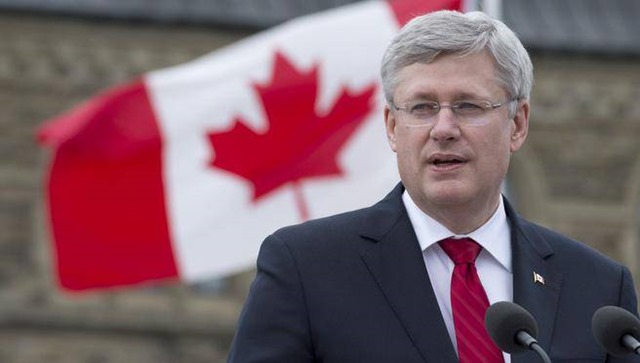 Three little-tent parties suit Stephen Harper just fine, because small, dirty and divided is his game, writes Ralph Surette. (ADRIAN WYLD / CP)
Watching Stephen Harper envenom not only the politics of the day but hammer at our deepest societal framework — the rule of law, democratic process — is to wonder what will be left of our self-respect as a nation if he wins the next election, thanks to a splintered electorate.
Once the light of the world on many fronts, Canada is now denounced regularly on environment, foreign aid and other things. Germany’s Bertelsmann Foundation, which rates governments every three years, has Canada slipping fast in “good government” ratings. Of the “high-quality governance structures” Canada once had in place, it said in its most recent report, “the actions of the Canadian government . . . have jeopardized this situation.”
Harper is a genius at totalitarian-style manipulation that feeds on the divisions that it has itself created, and at keeping the public confused. The fact that his party is still in the game at all according to the polls, despite one anti-democratic binge after another, attests to that.
Despite everything, he comes out with only a few light scratches over his scandalous attack on Supreme Court Chief Justice Beverley McLachlin on a trumped-up accusation.
This is not just a nasty spat. The Harperists have been attacking the courts from Day 1, and their problem is not with this or that judge — it is with the rule of law itself. The PMO’s reported fury at a string of setbacks suffered at the hands of the Supreme Court tells us ever more clearly that the Conservatives see the law as their plaything, to be bent to their purposes.
Harper is a clear-headed ideologue — all the more dangerous for that. Having bragged to the effect that “you won’t recognize Canada after I’m through with it,” his stated goal is to destroy the Liberal party and turn his own into the “natural governing party.”
The time for natural governing parties is probably over, but he can take some satisfaction in the reduced state of the Liberal party. The Harperists’ one telling argument is that Justin Trudeau “is not ready for prime time.” As regularly as Harper assaults democracy, Trudeau puts his foot in his mouth. And the recent signal given by its exclusion of pro-life candidates on the abortion issue is that the Liberal party is no longer a “big-tent” party. Three little-tent parties suit Harper fine, because small, dirty and divided is his game.
One would hope that by the time the next election rolls around in a year and a half, the game will be absolutely clear to the electorate. The idea of Harper in power another four years to rip up treaties, pervert the electoral process, pass manipulative omnibus bills, deepen the hold of oil and other resource companies over government, rig the tax system for partisan purposes, politicize the bureaucracy, plus attack environmentalists, scientists, civil society groups and parliamentary watchdogs, among others, should give us pause indeed.
Actually, many people get it now — the Harperists linger at some 20 per cent in the polls in Atlantic Canada and at 13 per cent in Quebec, raising the prospects of election night opening with fewer than a half dozen Conservative seats east of Ontario, and maybe none at all. The Prairies won’t budge much, despite some Conservative libertarians objecting to Harper’s iron grip, leaving Ontario and B.C. to decide. There, the Harperists are behind the Liberals, but not by much.
Harper’s argument there is that he’s going to heroically balance the budget and cut taxes. That is, he’s going to slash at everything, like services to veterans, and, especially, dump costs on the provinces. (Even the Parliamentary Budget Officer doesn’t know what exactly is being cut — that’s hidden in the last omnibus bill.)
With these savings, he’ll propose to cut taxes aimed at key voting groups in the money belts around Toronto and Vancouver that can be counted on to put self-interest above country.
If only Canadians saw what the outside sees. Once the light of the world on many fronts, Canada is now denounced regularly on environment, foreign aid and other things. Germany’s Bertelsmann Foundation, which rates governments every three years, has Canada slipping fast in “good government” ratings. Of the “high-quality governance structures” Canada once had in place, it said in its most recent report, “the actions of the Canadian government . . . have jeopardized this situation.”
Meanwhile, last November, with the media saturated with the Senate and Rob Ford scandals, Canadians heard nothing of the thrashing we got at the Warsaw Climate Change Conference, where several studies put us down with Saudi Arabia, which flares off oilfield gas, and a couple of others as one of the dirtiest nations on Earth per capita, thanks mostly to the tar sands.
Meanwhile, the opposition Liberals and NDP, which two-thirds of the electorate would like to see come together to put an end to Harper, instead are locked in their own frenzied combat, making it more likely that the Conservatives will slip through in those contested areas. And another Harper victory, even in a squeaky minority, would kill any chance that this country can retake its place as a positive force in the world.
Harper is a genius at totalitarian-style manipulation that feeds on the divisions that it has itself created, and at keeping the public confused. The fact that his party is still in the game at all according to the polls, despite one anti-democratic binge after another, attests to that.
Ralph Surette is a freelance journalist in Yarmouth County.
E-Mail: rsurette@herald.ca
 Ken Georgetti President, Canadian Labour Congress
12/04/2013 http://www.huffingtonpost.ca
The Conservative government is engaged in a campaign to distract their supporters from a series of Senate scandals and cover ups. The Conservative fundraising machine believes that if it feeds its base a constant diet of someone to dislike, the donation cheques will keep rolling in. Workers and their unions are their current targets with a long list of legislation designed to keep their base happy.
The Conservative government’s recent volleys against workers and their unions will only serve to undercut the well-being and security of middle-class families in Canada if they succeed in pushing through their anti-union legislation. The Globe and Mail said as much in a recent series of articles on growing inequality in Canada — “declining unionization has contributed to wage inequality.”
Canada’s labour movement is not just about decent jobs, it’s about a better life for everyone. Unions have worked to protect good jobs, make workplaces safer, fought for paid vacation time, public health insurance and the Canada Pension Plan. When union members stand up for fairness everyone benefits — whether you belong to a union or not.
Canadians will see through the government’s attempts to divide people against one another. At one end of the legislative spectrum, the government uses giant omnibus bills to throw everything but the kitchen sink into one piece of legislation. The current budget bill runs to 308 pages and in the fine print it makes sudden and dramatic changes to the Canada Labour Code. One of those changes would place workers’ lives at risk by eroding their right to refuse dangerous work.
Other amendments to federal labour laws would erode workers’ constitutional right to bargain collectively by letting the government unilaterally, without negotiation, change the rules for bargaining with their employees. To add insult to injury, witnesses to the parliamentary committee studying the bill who would speak out against the changes were deliberately scheduled to testify after the deadline for the committee to make amendments passed.
What is the government really trying to fix here? We know that well over 99 per cent of all collectively bargained contracts in Canada result in an agreement rather than a strike or lockout. There was no consultation with any of the parties affected by this proposed legislation, and changing the rules without consultation and negotiation is simply heavy-handed and unfair. Given the Supreme Court of Canada will soon rule on very similar legislation introduced by the Saskatchewan government, the ideological cousins of this government, it’s also premature.
At the other end of the legislative spectrum, the Prime Minister’s Office (PMO) is offending parliamentary tradition by using its influence to introduce Private Member’s Bills and to force their passage. That is what happened with Bill C-377, an unconstitutional piece of legislation that will force labour organizations (but no one else) to undertake costly and time consuming reporting of even the most minute of financial transactions.
Bill C-377 was supposedly the initiative of backbench Conservative MP Russ Hiebert but we know that special interest groups met frequently with the PMO, including the Prime Minister’s Chief of Staff Nigel Wright, and the PMO exerted pressure in order for the bill to pass.
The senate found Bill C-377 to be so offensive that it was sent back to the House of Commons in June with numerous amendments. But then the Prime Minister shut down Parliament and Bill C-377 is now going to be sent to the senate all over again. Bill C-377 is ideologically-motivated and aimed at wasting union members’ money and it is not needed. Our members already have access to financial information about the unions to which they belong.
Bill C-525, another Private Member’s Bill put forward by a Conservative MP, would make it nearly impossible for workers in the federally-regulated sector to join a union. The bill would consider workers who don’t bother to vote in a certification vote as casting “no” ballots on having a union. That’s not democratic — giving those who don’t vote control over those who do. If those rules applied to electing MPs, Parliament would be empty. One set of rules for Conservatives and a different set for workers — that’s unfair.
Finally, the recent Conservative Party convention in Calgary passed a number of aggressively anti-worker resolutions. One of them would allow some workers to stop paying union dues but still receive all the benefits that the union negotiates – all at the expense of their coworkers who do pay their dues. Leave it to ethically-challenged Conservatives, counselling people that it’s okay to dine and dash at a restaurant while leaving others at your table to pay the bill. That’s unfair and it’s a recipe for conflict and disruption in the workplace.
This government puts its extreme ideology ahead of all other considerations, but Canadians see these bullying tactics for what they are. The CLC and its affiliates ran a television advertising campaign during October and November 2013. We talked directly to Canadians about the positive role that the labour movement plays in our society. The response to our campaign has been overwhelmingly positive from both union members and the public at large. That response and our polling shows that we are on the side of the vast majority of Canadians. They will support a labour movement that works in the interest of fairness for everyone.
Ken Georgetti is president of the 3.3 million member Canadian Labour Congress.
 Larry Rousseau Regional Executive Vice President, Public Service Alliance of Canada
Posted: 11/23/2013 7:39 am http://www.huffingtonpost.ca
Stuffed into the 309-page Conservative budget implementation act, Bill C-4, that was tabled last month, are a slew of drastic changes to the federal labour relations system, which will affect the health and safety provisions, human rights protections, and collective bargaining rights of federal workers. As its number suggests, Bill C-4 is truly explosive.
On the health and safety front, the government is changing the Canada Labour Code to limit the rights of workers to refuse unsafe work, and also doing away with independent health and safety officers, relegating their responsibilities to political appointees of “the Minister.”
Meanwhile, another part of the bill will alter the Public Service Labour Relations Act (PSRLA) to prevent federal public service workers from accessing the Canadian Human Rights Commission and Tribunal over workplace discrimination complaints. Workers facing discrimination will instead have to file their complaint directly with their employer, which would have the power to promptly dismiss it for “being trivial, frivolous, vexatious or made in bad faith.”
Bill C-4 also guts public service collective bargaining by further modifying the PSLRA to allow the government to unilaterally determine which workers are essential and therefore forbidden from striking, without recourse to third party review. (At present, when the government and the union disagree on who is essential, either party can refer the matter to the Public Service Labour Relations Board, which ensures that neither side can exaggerate their assessment of who is essential or non-essential, a sensible system that has worked well over the years.)
Furthermore, Bill C-4 denies unions the right to refer a dispute to arbitration, unless more than 80% of workers are deemed essential. This means that the government would be able to declare 79% of workers in a bargaining group as essential, deny arbitration, and then force the remaining 21% minority to strike, in a classic attempt to divide and conquer workers in a given bargaining unit.
Arnold Heeney, the renowned Canadian diplomat and civil servant who led the Preparatory Committee on Collective Bargaining in the Public Service way back in 1963, noted in his memoirs that prior to free collective bargaining “there was great and growing dissatisfaction among government employees generally with the arbitrary and paternalistic system which continued to prevail…” As a consequence of this dissatisfaction and the stunning 1965 wildcat strike by postal workers, the government under Lester B. Pearson was forced to pass in 1967 the Public Service Staff Relations Act, which first codified the right to free collective bargaining as well as the right of public service unions to choose between strikes and third party arbitration to resolve disputes. And as Heeney further observed, though a number of politicians and labour leaders at the time predicted an explosion in the frequency of strikes, “the majority of civil servants chose the former route” of arbitration to resolve their disputes with government.
Indeed, the historical record has shown that major public service strikes have remained rather infrequent, but that the right of recourse to a strike has been critical to balancing the overwhelming power held by the government over public service workers. After all, the government not only has inherent power as the employer, it also has the power to set the rules of the game through legislation.
Yet today, we find ourselves with a government intent on turning back the clock almost 50 years by attempting to rig the labour relations playing field to the point where public service workers will be thrown back to that “arbitrary and paternalistic system” Heeney wrote about. And it would seem, of course, that the government couldn’t care less that the proposed changes to the PSLRA will effectively undermine the right to free collective bargaining under the Charter of Rights and Freedoms, which was affirmed by the Supreme Court in 2007.
Together, the dangerous, undemocratic and retrograde changes contained in Bill C-4 will directly impact some 800,000 Canadian workers subject to the Canada Labour Code in industries as diverse as rail, air, broadcasting, telecommunications and fisheries, in addition to well over 200,000 federal public service workers who fall under the PSLRA–approximately a million people in total.
Yet, the Conservatives have moved to limit debate in Parliament in an attempt to ram the bill through in the next couple of weeks. In fact, it has now emerged that labour changes in the bill were drafted secretly, without consulting law professors or labour-management experts (and certainly without consulting any of the unions representing federal workers).
It’s hard to imagine a reason for the callous health and safety changes, which needlessly endanger workers, but it’s clearly evident why the Conservatives are frustrating the collective bargaining process currently spelled out in the PSLRA.
Led by Treasury Board President Tony Clement, they have spent the last two years repeatedly attacking the pay and benefits of federal public service workers, claiming that these are out of line with the private sector. They say these workers, who deliver important quality public services like Old Age Security and food inspection to Canadians, are paid too much, but ignore that the Parliamentary Budget Officer recently reported that in the last decade–the latter part of which was shaped by the Conservative agenda–wages of federal workers have mostly just kept up with inflation. They also absurdly claim at every opportunity that federal public service workers take over 18 days of sick leave each year, again ignoring research from Statistics Canada demonstrating that this is simply not true.
The repetition of such claims–false as they are–serves the goal of creating a political atmosphere conducive to squeezing out from federal public service workers non-monetary benefits they negotiated over previous decades, often in lieu of their requests for raises that were said to be unaffordable, and therefore rejected, in the context of deficits during the Mulroney years, followed by pressures of debt repayment during the Chrétien years.
We’ve been down this road before. Just this past year, the government repeatedly overreached and tried to undermine free collective bargaining with public service workers only to be forced back to the table following action by unions. It did it with technical inspectors, whose many bargaining positions were later validated by a Public Interest Commission. It did it with foreign service officers, who then won a bad faith bargaining decision. And it did it with border services officers, who also won a court injunction against a forced vote. Bill C-4 undoubtedly presents an unprecedented assault on workers and the middle class, aimed at rewriting the very rules of the game. However, one at a time, the abusive sections of this law will be defeated.
Follow Larry Rousseau on Twitter: www.twitter.com/larryrousseau
 Andrew Phillip Chernoff