
Historic petition demonstrates there is no mandate to privatize

REGINA – 19,346 Saskatchewan voters have signed an online and physical petition saying no to privatization. Today the Own It! campaign and the Saskatchewan Federation of Labour (SFL) delivered 17,247 physical petition signatures to the Legislature, calling on the Sask Party government to stop its risky and costly privatization agenda.

“The Sask Party government has outright sold a number of crown corporations, weakened our utility crowns, and has privatized bypasses, hospital laundry services, correctional food services, MRIs, and is even building privatized schools and a privatized prison,” said SFL President Larry Hubich. “The broad support for this petition demonstrates that there is no appetite in Saskatchewan for privatization,” he added.

This petition is one of the largest in Saskatchewan’s history, and shows that Saskatchewan voters are looking for investment into their crowns and public services, not a sell-off to out-of-province corporations.

“This is the last Legislative sitting before next Spring’s provincial election,” said Hubich. “This clearly shows that it doesn’t matter which party wins the upcoming election, no government has a mandate to privatize and take away the benefits of strong crowns and public services,” he added.

In addition to the 17,247 Saskatchewan voters from 447 communities that signed the physical Own It! petition, 2,099 signed the online petition. All of those who signed the petitions are expecting the Sask Party government to stop its privatization schemes and instead invest in Crowns and public services.

The SFL represents over 100,000 working people across the province in 37 affiliated unions.

Source: Historic petition demonstrates there is no mandate to privatize | Canadian Union of Public Employees

CUPE stands in solidarity with Paris, Beirut

In response to shocking and disturbing violence that took place last week, including the events in Paris on November 13 and in Beirut on November 12, CUPE National President Mark Hancock spoke out on behalf of CUPE members.

“Our thoughts and condolences go out the family and friends of those killed and injured,” said Hancock. “Our thoughts are also with the first responders and health care workers who are on the front lines of the fight against terrorism. We thank them for their work, leadership and dedication in such difficult times.”

CUPE pledged its solidarity with the people of France, Lebanon, and all those around the world affected by senseless violence.

“We deplore these acts of violence,” said CUPE National Secretary-Treasurer Charles Fleury. “We will continue to work for peace and call on our government to end military aggression abroad, and on the international community to ensure that democracy and human rights prevail over violence and fear.”

Source: CUPE stands in solidarity with Paris, Beirut | Canadian Union of Public Employees

Corporations are looking to profit from social services | 2015 CUPE National Covention

A new form of privatization is pushing private sector involvement in social services like housing, child care and employment services.

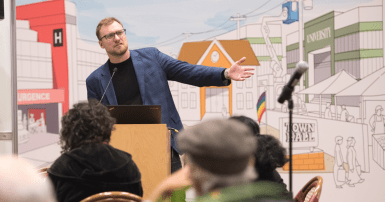
CUPE researchers Graham Cox and Sarah Ryan used a noon-hour speakers’ corner talk to expose social impact bonds as the latest way corporations are looking to profit from public services.

Private, for-profit financing is at the heart of these schemes. While social services are currently directly publicly funded by tax dollars, corporations and consultants want to profit from the distribution of those funds.

A social impact bond inserts a group of financiers and consultants between the government and the public service it delivers, said Cox. The private sector is guaranteed the money it fronts to provide the service, plus a hefty profit – up to 40% in one example Cox cited – if certain consultant-set targets are met.

In the case of an early childhood education project in Chicago, that means corporations are guaranteed $9,100 per year for every child from the program who does not need special education. This creates the motivation to deny children with special needs access to the program, in order to boost the results.

The motivation to make a profit distorts service delivery priorities and what is defined as a successful outcome, said Ryan, speaking about the for-profit project in Chicago.

“Consultants, evaluators, bankers are now deciding what services to provide, where those services should be provided, and who can access them. It’s no longer the common good as the overriding consideration,” she said.

Canadian Union of Postal Workers National President Mike Palecek was invited to kick off the talk by giving an update on the fight to stop cuts and privatization at Canada Post. He described how CUPW made door-to-door delivery a major issue in the federal election.

Palecek outlined the fight ahead to keep pressure on the new Liberal government to roll back the cuts that have already been made, now that Canada Post has halted its plans.

Learn more about social impact bonds at cupe.ca/privatization and citizenspress.org/social-impact-bonds.

Source: Corporations are looking to profit from social services | Canadian Union of Public Employees

Strategic Directions day 2: Strengthening our plan | 2015 CUPE National Convention


November 4, 2015

Connecting with members, building a more inclusive union, creating safe and healthy workplaces, and fighting privatization were front and centre in discussions about Strategic Directions on Wednesday morning.

Delegates resumed debate on CUPE’s blueprint for the next two years with discussions about the importance of health and safety activism.

CUPE 1623 vice-president Sharon Richer described the urgent need for action for health care workers, who face on-the-job assaults.

“Violence is not a part of our job. We all have a right to a safe, violence-free workplace,” said Richer.

Strategic Directions proposes that 2016 be a year focused on health and safety. CUPE 2669 member and national health and safety committee co-chair Dolores Douglas said the plan will re-energize CUPE and is a great way to connect with members, especially precarious workers.

Fighting privatization was another focus, with delegates calling for solidarity across sectors and targeted resources for locals under attack.

Barb Biley, CUPE 6179 and Hospital Employees’ Union member, told delegates how important it was to be able to quickly mobilize workers across sectors to fight contracting out at a seniors’ home. Building members’ capacity to fight back, and involving all workers in a region, is essential to keep winning these battles, she said.

Kirk Mercer of CUPE 951 and Randy Fennell of CUPE 728 both pointed to apprenticeships in the skilled trades as another way to defend public services against contracting out. They called for support to maintain and expand apprenticeship programs across the country.

Delegates discussed the need to keep building CUPE’s member-to-member organizing through the Fairness program, as well as the need to engage and connect with young and precarious members – building a truly inclusive and diverse union.

Source: Strategic Directions day two: Strengthening our plan | Canadian Union of Public Employees