
The lives of almost one million Canadian workers will be placed in danger as a result of cynical amendments that the Conservative government is making to the Canada Labour Code. Buried deep in the government’s latest budget bill tabled on October 22 are amendments to the health and safety provisions of the Code that have nothing to do with balancing the budget, and everything to do with putting workers’ lives at risk. Watch this video to learn more on how you can help stop this.
Category Archives: civil liberties
Unions plan public fight over federal labour reforms
Canadian Labour Congress says Ottawa ‘declared war’ by pushing changes without consultation
By Trinh Theresa Do, CBC News Posted: Nov 21, 2013 5:00 AM ET

Tony Clement says the labour reforms will “bring savings, streamline practices and bring them in line with other jurisdictions”

Tony Clement on public service right to strike 9:51
Related Stories
- Read C-4, the second budget implementation bill (pdf)
- Clement defends move to limit civil servants’ right to strike
- Right to strike by civil servants curtailed by budget bill
In a sign they have all but given up on talks with the Treasury Board over labour reforms proposed in the federal government’s budget bill, union leaders say they are taking matters into their own hands.
The Canadian Labour Congress quietly met with more than 100 representatives from unions across the country this week to plot a long-term strategy to engage both the public and union members in pressuring the government to reverse its proposed labour law changes. The CLC represents more than 3 million workers across the country.
The CLC has already wrapped up a series of television ads that ran over the past six weeks. Its next step is to reach out to each of its own members in a campaign that will detail how reforms in the budget bill will affect their bargaining rights.
And then, according to CLC secretary-treasurer Hassan Yussuff, union members must appeal directly to their MPs.
“They need to, of course, take direct responsibility to how they’re going to start speaking out on behalf of their union, on behalf of themselves,” said Yussuff. “And more importantly, in terms of the gains they have made to ensure this government doesn’t take that away.”
‘Government had declared war on us’
Yussuff said this offensive strategy will become the “new normal” unless policy changes are reversed.
“I think the government had declared war on us,” he said. “We didn’t start any of these measures — the government itself has done so. I think it’s fair for us to respond to their actions.”
If passed, Bill C-4 would make sweeping changes to a number of labour laws, including the Canada Labour Code and Public Service Labour Relations Act.
Among other things, it would streamline collective bargaining by allowing the government to determine which services are essential and make it illegal for those workers to strike. In situations where 80 per cent or more of workers in a bargaining unit are designated essential, the only dispute resolution method is arbitration.
In a statement sent to CBC News, Treasury Board president Tony Clement said the Public Service Labour Relations Act is being amended to ensure that the public service is modern and affordable.
“The proposed amendments will bring savings, streamline practices and bring them in line with other jurisdictions. Our government will sit at a bargaining table on behalf of the taxpayer where the rules are fair and balanced.”
Unions were not consulted in the drafting of the reforms. Labour leaders have since tried to meet with Clement to present counter-proposals, with little success.
Robyn Benson of the Public Service Alliance of Canada recently had a meeting with Clement during which she proposed he withdraw changes from the budget bill to allow for more consultation.
She wrote on her blog afterwards, “He stated bluntly that he had no intention of consulting with us, and that he wanted all his changes in place for the next round of collective bargaining — in fact, by Christmas.”
In response, Clement tweeted, “That’s also the meeting where you claimed co-governance with Parliament. Takes ‘union boss’ to a whole new level.”
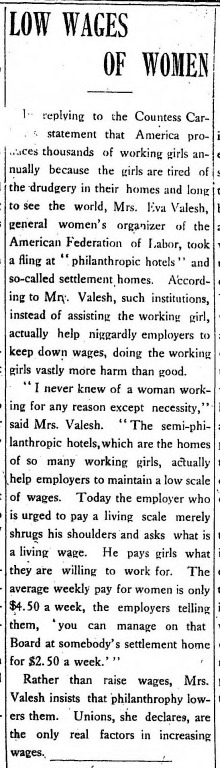
Unions…The Only Real Factors In Increasing Wages, So Says Mrs. Eva Valesh
NOTE: Women have been involved in the Labour Movement for untold generations, advocating proper working conditions, fair wages, and worker rights throughout Canada and the United States. One such woman was Mrs. Eva Valesh, general women’s organizer of the American Federation of Labour.
Mrs. Valesh knew then, what Unions and Canadians know today, Union wages lift the wages of all people and stimulate local, regional, provincial economies. Canada is a better country for the inclusion of Unions. Enjoy the article.
From: Boundary Creek Times, Greenwood, B.C., July 15, 1910
NSA North: Why Canadians should be demanding answers about online spying
By Adam Kingsmith| July 22, 2013 http://rabble.ca

“We are living in an age of surveillance,” concludes Professor Neil Richards, privacy law and civil liberties expert at Washington University. “There’s much more watching and much more monitoring, and I think we have a series of important choices to make as a society — about how much watching we want.”
Last month’s realisation that the U.S. National Security Agency (NSA) — by means of a top-secret program codenamed “PRISM,” has been trawling the audio, video, photo, email, and phone records of millions of Americans at home and abroad, serves as a stark reminder to those of us living in supposed “liberal democracies” that we’ve increasingly allowed state-surveillance mechanisms to become normalised and domesticated in a post 9/11 world.
Since the early 2000s, considerable advances in personal technology and the public’s broad tolerance of monitoring — due in part to illusory fears concerning the exacerbated threat of terrorism, have served to strengthen government capabilities and legal justifications to covertly monitor and record the digital activities and behaviours of entire populations.
Additionally, we’ve learned that private technology companies such as Google, Microsoft, Apple, and Facebook — institutions that repeatedly preach customer confidentiality, have been quietly supporting programs such as PRISM all along by providing government agencies with warrantless access to massive amounts of our personal user information.
Of course, some Canadians will probably brush off these revelations.
After all, PRISM is a U.S. government program, Google, Microsoft, and Facebook are American corporations, clearly this breech of privacy and constitutionality is an American problem, and we Canadians would best to just keep quiet and let them figure it out right?
Wrong. Dead wrong.
What these people fail to realize is that when it comes to the Internet, an American problem is everyone’s problem because the World Wide Web is essentially under U.S. jurisdiction.
“There is no border,” emphasises Professor Ron Deibert, head of the Citizen Lab at the University of Toronto. “The way telecommunication traffic is routed in North America, the fact of the matter is about 90 per cent of Canadian traffic — no one really knows the exact number — is routed through the United States.”
Thus the telecommunications infrastructure of Canada is inextricably linked to the United States. This means that the vast majority of Canadian metadata — data that describes other data, is filtered through NSA-monitored Internet exchange points, and these points serve as informational intersections where “personal” user traffic is transferred between websites.
As we only have two Internet exchange points in Canada, an email sent from a Toronto server could pass through Chicago, Los Angeles, even Miami, before being routed back to Canada — along the way its content can be subsumed via filters and checkpoints monitored by American intelligence agencies which stress that while surveillance programs such as PRISM do not target U.S. nationals, the data of foreigners — i.e. Canadians, are fair game.
In short, the U.S.-centric architecture of the Web — coupled with the fact that copying and storing massive amounts of data has become relatively easy, makes it inevitable that some personal communiqués between Canadians will be subjected to American data mining.
Unfortunately, the NSA monitoring Canadian information in transit is just the tip of the surveillance iceberg up here. Raw documents brought to light through the Access to Information Act reveal that the Harper Administration has silently implemented a surveillance program of its own modeled after the scope and reach of the NSA’s PRISM.
Administered by the mysterious Communications Security Establishment Canada (CSEC) — a highly secretive government agency that employs 2,000 people and has an annual budget of about $422 million, this “PRISM-North” intercepts domestic communications to order to cultivate metadata from phone records, Internet protocol addresses, and other data trails.
If armed with enough raw computing power to sift through gigantic pools of data, all of this metadata — essentially a record of who we know, and how well — can then be used to map our social networks, patterns of mobility, professional relationships and personal interests.
What’s more, oversight of CSEC is practically non-existent — even when compared with the NSA. “PRISM-North” is scrutinized by a lone retired judge who issues an annual review — concealed from parliamentarians, journalists and the public, a review that in all its years has never reported a single invasion of privacy by CSEC that would merit further inquiry.
Subsequently, while the extent of CSEC’s current monitoring activities are kept confidential from everyone except the Minister of Defense, the agency has not only reconfirmed it is collecting metadata, CSEC also said this data is being shared with the so-called “Five Eyes” — a clandestine group of intelligence agencies from Australia, New Zealand, U.S. and U.K.
I know what many of you are thinking. This is Canada, we have rights — doesn’t a federal agency like CSEC warrantlessly monitoring, stockpiling and sharing all of my private data not violate the Canadian Charter of Rights and Freedoms in some really big way?
Shockingly no.
“Canada has similar disclosure provisions as those found in the USA Patriot Act,” asserts Professor Michael Geist, technology law expert at the University of Ottawa. “For example, s. 21 of the Canadian Security Intelligence Act provides for a warrant that permits almost any type of communication interception, surveillance or disclosure of records for purpose of national security.”
Listening to our phone calls, monitoring our Internet searches, scrutinizing our emails, trawling our social media accounts, and sharing it all with intelligence agencies around the world — these things are not only possible, but as the law suggests — entirely legal. And as virtually everything is shrouded in secrecy, there’s no way to know how deep this goes.
Now that technology has caught up with the ambitions of government intelligence agencies, we are seeing a move away from targeted surveillance — where law enforcement would be granted limited powers to investigate by judicial ruling, to a sort of dragnet paradigm — where law enforcement is permitted to amass as much information as possible, sort through said information at its leisure, and then discard the irrelevant bits later, maybe.
So as cries for increased transparency and civilian oversight ring out from our neighbours to the south, it is time for Canadians to speak up against the spying taking place within our own country as well. Only by fighting surveillance and secrecy with discourse and dissent can we start to pull back the veil of suppression to recapture the agency in our democracy.
Adam Kingsmith has an M.A. in International Relations and his writing and research explores the linkages between technology, culture, and political dissent within a uniquely Canadian context. He currently splits his time between his hometown of Vancouver and Toronto.
 Andrew Phillip Chernoff