Canada needs a jobs and training strategy: Georgetti comments on disappointing July job numbers

 
Friday, 9 August 2013


OTTAWA ― The President of the Canadian Labour Congress says that the job numbers for July are a big disappointment and he is calling on the federal government and employers to invest in both job creation and training.  

“Our economy lost 39,400 jobs in July and the unemployment rate is up. This is a wakeup call and we want governments and private sector employers to invest in job creation and training. 

Georgetti was commenting on the release by Statistics Canada of its Labour Force Survey for July 2013. There were 1,380,300 unemployed Canadians in July and the overall unemployment rate was 7.2%. In the 15-to-24 age group, unemployment stood at 13.9%, and 47.9% of young workers are employed only part-time.

Georgetti says that the federal government should assist in creating good jobs by participating in a long-term program to replace and extend Canada’s ageing physical and social infrastructure in roads, rapid transit and child care. “We have cement chunks falling off of bridges and tractors falling into city sinkholes. There is a lot to be done and the government should get at it.”

He adds that Ottawa has provided billions in corporate tax giveaways in the expectation that companies would invest in job creation and training. “Our research has shown that those companies are generally sitting on the cash instead of investing it in job creation and training. It’s high time for them to put that money to  work in the economy.” 

Quick Analysis from CLC Chief Economist Sylvain Schetagne

Government austerity measures and job cuts hurt employment growth in Canada in July 2013. The number of people working decreased significantly by 39,400 in July 2013, and another 14,200 simply quit looking for work and left the labour market. As a result, the unemployment rate rose 0.1% to 7.2% and the percentage of the population working decreased (from 61.9% to 61.7%). Jobs were lost mainly in the public sector, with 74,000 fewer jobs in this sector as a result of declines in health care and social assistance (-47,000) and public administration (-22,900). Growth did occur in the private sector but the number of jobs in manufacturing remains lower than a year ago in July (-59,500). Young workers were hard hit in July. Compared to the previous month, there was decrease of 45,600 jobs among workers aged 15-24, while another 48,800 left the labour market. As a result, their unemployment rate is 13.9%, up from 0.1% from last month.

The Canadian Labour Congress, the national voice of the labour movement, represents 3.3 million Canadian workers. The CLC brings together Canada’s national and international unions along with the provincial and territorial federations of labour and 130 district labour councils.

Web site: www.canadianlabour.ca
Follow us on Twitter @CanadianLabour

Contacts:  Sylvain Schetagne, CLC Chief Economist, 613-526-7445.
Dennis Gruending, CLC Communications: Tel. 613-526-7431.
Cell-text: 613-878-6040. Email: dgruending@clc-ctc.ca

The middle class: The battleground of all politicians

Monia MazighBy Monia Mazigh August 9, 2013 http://rabble.ca

Photo: Peter Klein/flickr

In the U.S., the “M” word has been on the lips of politicians from the left to the right of the political spectrum, albeit for different reasons. President Obama is not an exception. Indeed, he made the mention of the middle-class part of his electoral rhetoric immediately after the 2008 financial crisis and after hundreds of thousands of Americans lost their houses, their American dream.

Last February, in his State of the Union address, Obama declared it was “our generation’s task” to “reignite the true engine of America’s economic growth — a rising, thriving middle class.” A few days ago, on August 5, he spoke in a gathering and he again pondered the same message, to “secure a better bargain for the middle class.” Whether we agree with Obama’s plan to revive the middle class or not, one must admit that he has been quite explicit about it. It includes measures affecting child care, dependent care, college expenses and retirement savings.

Here in Canada, Justin Trudeau is on the footsteps of Mr. Obama and his talk is all about the middle class. The only difference is that we don’t have any idea how Justin Trudeau is going to tackle the middle-class issue. Is he going to continue to give free rides to corporations as both Liberal and Conservative governments did in the past, or will he be offering a real program with fiscal and economic measures specifically targeted to the fading middle class? (Even though a lot of words are being said about the new Liberal star candidate in Toronto Centre and how her book might make up the next platform for the Liberal Party campaign). Or is he only interested in the votes of this class and then will turn his back and continue to help the big corporations instead?

But in reality, do we still have a “real” middle class? Where does the political opportunism start and where does the economic reality end?

In the last two decades, generations of politicians watched the erosion and the crushing of the middle class. Some denounced the situation and stood by their principles but many nodded and acquiesced to all the economic and social measures making the poor poorer and the rich richer, effectively shrinking the middle class.

According to a report prepared by Canadian bureaucrats and presented to Finance Minister Jim Flaherty, and recently released by Postmedia, Canada’s middle class improved its average income only by seven per cent between 1976 and 2010. This is equivalent to 0.2 per cent per year. The median income of this class did not do better. From 2007 to 2011, it grew from $66,700 to $68,000, a mere 0.5 per cent per year.

This assessment is confirmed by another report that was prepared by TD Bank. The report documents the fact that low-wage and middle-wage jobs in Canada have been shrinking as a share of the economy as job growth focuses more and more on high-skilled, high-end jobs. Meanwhile, the spending by the middle class didn’t decrease. To the contrary, it continued to increase and the funding comes from the larger amount of debt Canadian families are contracting from the banks and other financial institutions, making the Canadian household one of the most indebted in the OECD countries with a debt-ratio of around 161 per cent for the first quarter of 2013. 

Mark Carney, the former governor of the Bank of Canada, never missed an opportunity to speak against the high amount of debt that is contracted by Canadians. The government never raised an eyebrow (until they changed the rules for mortgages). They barely reacted to the horrifying numbers of children who now live in poverty. Canada’s child poverty rate increased between the mid-1990s and the late 2000s. These are not only children born to single parents of low-income families but also to working parents who can’t make enough annual earnings to afford all the basic necessities for their families. The Conference Board of Canada reported that Canada scores a “C” grade and ranks 15th out of 17 peer countries. Moreover, more than one in seven Canadian children live in poverty.

Last July, the city of Detroit in the U.S., where the middle class was first formed by the autoworkers and later by public employers running city services, went bankrupt. The fall of the auto industry, the cuts to public funds, the fiscal structure of the American government and many other socio-economic factors took Detroit to the cliff; it was forced close shop. It is interesting nowadays to watch the Conservative government trying so hard to dismantle the unions in Canada and to slash thousands of jobs in the public sector. Yes, it would be both stretched out and simplistic to draw similarities between Detroit and the path Canada is following. Nevertheless, it is crucial to study the effects of recent public sector cuts and their impacts on the Canadian middle class, and the state of our economy in general.

The middle class today is like a beautiful woman, desired and solicited by everyone but insidiously feared and despised by all. The politicians are no exception.

Monia Mazigh was born and raised in Tunisia and immigrated to Canada in 1991. Mazigh was catapulted onto the public stage in 2002 when her husband, Maher Arar, was deported to Syria where he was tortured and held without charge for over a year. She campaigned tirelessly for his release. Mazigh holds a PhD in finance from McGill University. In 2008, she published a memoir, Hope and Despair, about her pursuit of justice, and in 2011, a novel in French, Miroirs et mirages.

Photo: Peter Klein/flickr

Show Canadian Parties Who’s Boss

Voters, think yourselves employers, and would-be politicos your job seekers. Give ’em hell.

By Crawford Kilian, August 9, 2013, TheTyee.ca

Ever since the failure of the B.C. New Democratic Party to win the May election, dissidents within the party have blamed everyone from Adrian Dix to campaign manager Brian Topp and party president Moe Sihota. Plenty of outsiders have offered their own analyses and recommendations, not always well meant.

No doubt the usual suspects deserve the criticism, but I suspect the real problem is voters’ failure to remember that a democracy is an enterprise where the voters — not the parties — are the boss.

Politicians pay lip service to that idea, but they’re happier with promoting themselves as “leaders” we should happily follow. The media take the cue from the politicians, running endless stories about what the prime minister, premier, or some cabinet minister is doing. Then they profess to be scandalized to report how politicians are exploiting their perks and charging $16 orange juice to the voters’ tab.

Running in parties is a convenience for politicians, who get a better chance of election in exchange for accepting party “discipline.” The parties are less convenient for voters because party promises rarely match performance. This leads to cynicism among politicians and voters alike, and that leads to apathy and still more political abuse. A democracy can’t prosper with absentee owners; someone’s got to mind the store.

While voters have ignored their responsibilities, all parties have ignored the demographic, environmental and economic changes transforming Canada along with the rest of the world. Older Canadians may still be voters, but they notably failed to bring up their kids to take voting seriously. Robins are showing up in the Arctic while swallows vanish from the Lower Mainland. Technology has made countless industries obsolete.

Reframing the parties

We won’t solve our political problems with a reformed or abolished Senate, or a more civilized Question Period, or less whipping of backbenchers. We can’t get rid of parties, but we should reframe them, so they always remember that they’re just so many job applicants. We are their employers, elections are hiring interviews, and once hired they had damned well better deliver on what they promise.

Here’s what every federal and provincial political party, regardless of ideology, should offer Canadians:

1. Its own concept of a social contract, explaining its view of taxes and what we can reasonably expect from our investment: a country where we collectively look after basic support systems so we can individually get on with our lives. The difference between parties would be in the definition of “basic support.”

2. Redefinition of the role of MP/MLA, not so much as “people’s representative” but as “people’s agent,” like the agents of movie stars and athletes: MPs would look after the details to ensure their constituents have both immediate work and meaningful long-term careers. Like agents’ income, MPs’ income would depend on that of the voters. Government MPs and MLAs would take pay cuts based on double their home riding’s unemployment rate: a five per cent unemployment rate this quarter means 10 per cent less on the MP’s next-quarter take-home pay and eventual pension. That might make backbenchers less whippable.

3. A detailed business plan for the province or country. This wouldn’t be just to go on doing what we’ve always done, but also to argue what we should plan to do when the resources run out or a natural disaster hits. The Finnish government is currently working “to make Finland the most competent country in the world by 2020.” Canada could and should give the Finns some competition on that score.

The business plan would include how to fund full healthcare, with demographic sustainability over next 50 years, minimum; provide free education to all as an investment to ensure sustainability; strong support for young families; and active recruitment of immigrants who can also maintain cultural and trade links with their home countries.

The plan would also include heavy support for scientific and technological research and development: R&D will drive change in all countries, so we need to keep pace. The next tech revolution could come in computers or synthetic biology, or something completely unforeseen. So the party wouldn’t bet on training particular kinds of workers (which would subsidize industries that may already be finished), but on the general education of highly literate citizens who could well invent a scientific revolution we can’t even imagine yet.

A party without such a business plan should be shown the door.

4. A vision of the poor not as a problem to be solved but an opportunity to be seized, through better education and the provision of more meaningful work. With so few young workers and so many retirees to support, we can’t afford to waste the productivity of any worker. We may quarrel about levels of support, but not about support itself.

Listening like smart employers

When elections come, we should consider ourselves employers listening to very anxious job seekers who want control over very large sums of our money. They should be able to tell us what they’d do with that money, and what kind of return they’d get on it.

Smart employers know bullshit when they hear it, especially when it’s obviously what the applicant thinks they want to hear: “Gee, I’m a team player, I’ve got ideas that will save you money, I’ve got a passion for this field, you won’t be disappointed if you hire me.”

Better to hear an applicant who looks you in the eye and says: “You’ve got big problems. This is what I think they are, this is what they’re costing you, and this is how you might start to fix them. If you don’t agree, thanks for your time and good luck.”

We’re too big a country for populist micro-management. But on the day the government calls a new election, it should be legally obliged to submit a balance sheet on what it’s spent, what it’s borrowed, and how many of its promises it’s actually kept. The balance sheet would be drawn up by the Parliamentary Budget Officer, not by anyone answering to the government itself, and the Opposition would be free to present its own critique.

Reframing our parties along these lines wouldn’t solve all our problems. As the great American journalist H. L. Mencken observed, “Democracy is the theory that the common people know what they want, and deserve to get it good and hard.”

But we’re all the common people, and we sometimes learn from experience whether we like it or not. We don’t always fall for warmongers, racketeers, or pretty faces. If experience teaches us that the present party system (which has never been in any of our Constitution Acts) is treating us poorly, we can still remember who’s supposed to be the boss, and who are just the well-dressed flunkies we’ve hired to work for us.  [Tyee]

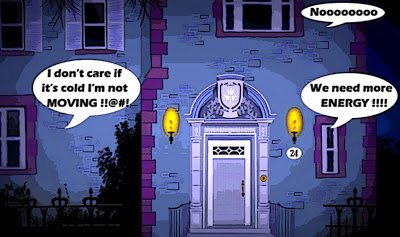
Stephen Harper and The Nightmare at 24 Sussex Drive

From:  http://montrealsimon.blogspot.ca/

OMG. It’s another Con scandal AND a horror show at the same time. A Nightmare at 24 Sussex Drive.

The old mansion is crumbling, but Stephen Harper is refusing to move out !!!

With Prime Minister Stephen Harper declining to move his family out of 24 Sussex Drive, the National Capital Commission has been unable to perform substantial renovations to curb rising energy costs at the official residence.

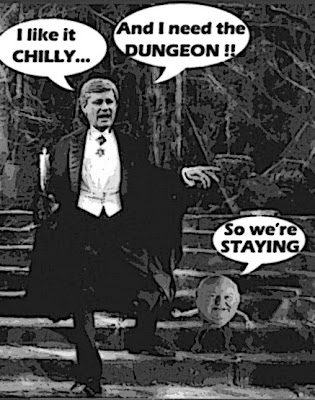
He won’t leave the Big House, even though it’s costing taxpayers an arm and a leg to keep it at body temperature.

The NCC last year spent more than $69,000 on heat and hydro for the 145-year-old home, billing records obtained through the Access to Information Act show. That’s up about 20 per cent from the Harpers’ first year in the home, largely because of increased energy rates.

And even though it means the next Prime Minister will have to be the one to move out. Or wear a hard hat in the house, and a fur coat to bed.

Or sleep in a box like he does…

Can you believe that eh? Is that a selfish energy hog vampire or WHAT?

And just at a time when he’s trying to convince Obama to approve the Keystone XL pipeline.

By posing as an environmentalist…

While blowing hot air out of every chimney and every ORIFICE.

Gawd. It’s so horrible, so embarrassing, so humiliating.

But then what what do we expect eh? When we live in the Banana Republic of Harperland where public servants have to use their OWN money to find out what the Con regime is plotting.

Officials at Parliament’s budget watchdog office say they are using their own money to file access to information requests in order to reduce government interference.

Interim Parliamentary Budget Officer Sonia L’Heureux recently said in a statement that a majority of departments and agencies are still withholding information on the impact of billions in federal spending cuts.

Because he would blind us while he kills our country.

Strangle our values like a python.

And force us to live in his own sinister darkness…

“This is a government which controls all information, all access to information, all material upon which a reasonable voter could make up his or her mind with factual information, and they just shut that down in favour of the massive Conservative propaganda machine.

Where ignorance is strength, madness rules, and hope goes to die.

Oh boy. I hope the day Stephen Harper is forced to move out of 24 Sussex Drive it’s live on TV eh?

Because it’s going to be the BEST moving day this country has ever seen.

And when he dares emerge from his dilapidated mansion in the fall, if the police haven’t taken him to live in THEIR Big House.

Let’s make sure he gets this message:

Monster, Monster, the sun is rising.

Steve, Steve, it’s time to LEAVE…