
SURETTE: Harper could still hang on, even after defacing Canada

http://thechronicleherald.ca     ralph Surette    May 16, 2014
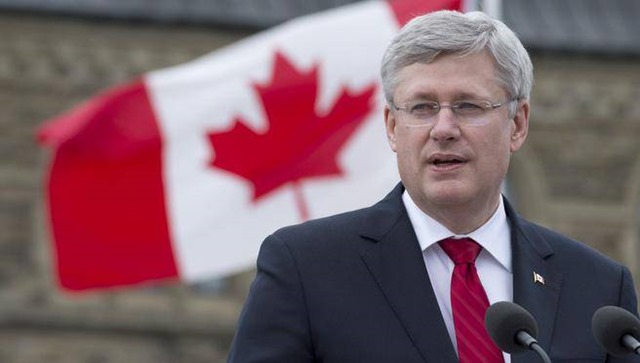
B97319909Z.120140516151800000GUH5J504.11           Three little-tent parties suit Stephen Harper just fine, because small, dirty and divided is his game, writes Ralph Surette. (ADRIAN WYLD / CP)

Watching Stephen Harper envenom not only the politics of the day but hammer at our deepest societal framework — the rule of law, democratic process — is to wonder what will be left of our self-respect as a nation if he wins the next election, thanks to a splintered electorate.

Once the light of the world on many fronts, Canada is now denounced regularly on environment, foreign aid and other things. Germany’s Bertelsmann Foundation, which rates governments every three years, has Canada slipping fast in “good government” ratings. Of the “high-quality governance structures” Canada once had in place, it said in its most recent report, “the actions of the Canadian government . . . have jeopardized this situation.”

Harper is a genius at totalitarian-style manipulation that feeds on the divisions that it has itself created, and at keeping the public confused. The fact that his party is still in the game at all according to the polls, despite one anti-democratic binge after another, attests to that.

Despite everything, he comes out with only a few light scratches over his scandalous attack on Supreme Court Chief Justice Beverley McLachlin on a trumped-up accusation.

This is not just a nasty spat. The Harperists have been attacking the courts from Day 1, and their problem is not with this or that judge — it is with the rule of law itself. The PMO’s reported fury at a string of setbacks suffered at the hands of the Supreme Court tells us ever more clearly that the Conservatives see the law as their plaything, to be bent to their purposes.

Harper is a clear-headed ideologue — all the more dangerous for that. Having bragged to the effect that “you won’t recognize Canada after I’m through with it,” his stated goal is to destroy the Liberal party and turn his own into the “natural governing party.”

The time for natural governing parties is probably over, but he can take some satisfaction in the reduced state of the Liberal party. The Harperists’ one telling argument is that Justin Trudeau “is not ready for prime time.” As regularly as Harper assaults democracy, Trudeau puts his foot in his mouth. And the recent signal given by its exclusion of pro-life candidates on the abortion issue is that the Liberal party is no longer a “big-tent” party. Three little-tent parties suit Harper fine, because small, dirty and divided is his game.

One would hope that by the time the next election rolls around in a year and a half, the game will be absolutely clear to the electorate. The idea of Harper in power another four years to rip up treaties, pervert the electoral process, pass manipulative omnibus bills, deepen the hold of oil and other resource companies over government, rig the tax system for partisan purposes, politicize the bureaucracy, plus attack environmentalists, scientists, civil society groups and parliamentary watchdogs, among others, should give us pause indeed.

Actually, many people get it now — the Harperists linger at some 20 per cent in the polls in Atlantic Canada and at 13 per cent in Quebec, raising the prospects of election night opening with fewer than a half dozen Conservative seats east of Ontario, and maybe none at all. The Prairies won’t budge much, despite some Conservative libertarians objecting to Harper’s iron grip, leaving Ontario and B.C. to decide. There, the Harperists are behind the Liberals, but not by much.

Harper’s argument there is that he’s going to heroically balance the budget and cut taxes. That is, he’s going to slash at everything, like services to veterans, and, especially, dump costs on the provinces. (Even the Parliamentary Budget Officer doesn’t know what exactly is being cut — that’s hidden in the last omnibus bill.)

With these savings, he’ll propose to cut taxes aimed at key voting groups in the money belts around Toronto and Vancouver that can be counted on to put self-interest above country.

If only Canadians saw what the outside sees. Once the light of the world on many fronts, Canada is now denounced regularly on environment, foreign aid and other things. Germany’s Bertelsmann Foundation, which rates governments every three years, has Canada slipping fast in “good government” ratings. Of the “high-quality governance structures” Canada once had in place, it said in its most recent report, “the actions of the Canadian government . . . have jeopardized this situation.”

Meanwhile, last November, with the media saturated with the Senate and Rob Ford scandals, Canadians heard nothing of the thrashing we got at the Warsaw Climate Change Conference, where several studies put us down with Saudi Arabia, which flares off oilfield gas, and a couple of others as one of the dirtiest nations on Earth per capita, thanks mostly to the tar sands.

Meanwhile, the opposition Liberals and NDP, which two-thirds of the electorate would like to see come together to put an end to Harper, instead are locked in their own frenzied combat, making it more likely that the Conservatives will slip through in those contested areas. And another Harper victory, even in a squeaky minority, would kill any chance that this country can retake its place as a positive force in the world.

Harper is a genius at totalitarian-style manipulation that feeds on the divisions that it has itself created, and at keeping the public confused. The fact that his party is still in the game at all according to the polls, despite one anti-democratic binge after another, attests to that.

About the Author

ralph Surette

Ralph Surette is a freelance journalist in Yarmouth County.

E-Mail: rsurette@herald.ca

It ain’t easy to spin dismal job numbers

Home

The Conservative government relied on a familiar refrain to try to spin its way out of Friday’s awful jobs report released by Statistics Canada.

First, the facts:
  • Over the past year, “one full-time job was added for every four part-time jobs.”
Second, the analysis from Bay Street:
  • Scotiabank note calls jobs numbers a shocker, weakest job growth by far since the recession.”
  • “Disappointment across the board,” said Mark Chandler, head of fixed income and currency strategy at RBC Capital Markets.
  • “That full-time employment growth is nearly flat in the past year while part-time job growth is up 2.5 per cent ‘indicates that businesses are not eager to expand payrolls,'” said Arlene Kish, senior principal economist at IHS Global Insight.
Third, a recap of past Conservative spin:

Whenever faced with bad economic news, the Conservatives claim that Canada leads the G-7 in jobs and economic growth since the recession. They make this misleading statement by using selective statistics.

When population growth and purchasing power are taken into account to get the complete picture, Canada falls behind G-7 countries Germany, Japan and the United States. That’s fourth place (out of 7!).

Fouth, the go-to spin:

Watch Industry Minister James Moore try to spin the bad news using the “Yah, but we’re still #1” discredited stat.

No shortage of workers – just a shortage of training

Tue, 11/19/2013 – 10:06
Posted by Andrew Jackson     http://www.broadbentinstitute.ca

Two major recent studies – from Derek Burleton and his colleagues at Toronto-Dominion Bank, and from former senior federal government official Cliff Halliwell published by the Institute for Research on Public Policy – provide excellent overviews of recent developments in the Canadian job market, and an informed framework for thinking about our future skills needs.

This message seems to have finally got through to the Harper government. In a speech to the Vancouver Chamber of Commerce on November 14, Employment and Skills Development Minister Jason Kenney told employers to stop complaining and to stop relying excessively upon temporary workers. Instead, he said, employers should “put more skin in the game” by increasing wages in high-demand occupations and by investing more in the training of Canadians.

The TD and IRPP studies provide balanced overviews of our future skill needs. Neither see generalized shortages as an acute danger, notwithstanding the pending (if increasingly delayed) retirement of the baby boom generation. Indeed, Mr. Halliwell says we should welcome a tighter job market, after years of stagnant real wages for most workers.

Graduates from our postsecondary education system, together with new immigrants, will more or less match job vacancies opening up due to the retirement of highly skilled workers. And employers can be expected to minimize shortages as they emerge by investing in capital and skills so as to raise productivity.

All that said, these studies note that we face some specific skills shortages today in a limited number of occupations and regions, and that some employers may face increasing difficulties finding workers with the right education and skills to fill available jobs in the future.

This can, however, be seen more as an opportunity than a curse, given the significant unemployment and underemployment of today, especially for youth, recent immigrants and aboriginals. The challenge is to invest in skills to increase access to good jobs for Canadians who want to get ahead, and thus to forestall future shortages that might lower our economic potential.

One set of policies that makes sense is to raise the education and skills level of marginalized groups and to ensure that unemployed workers, especially the long-term unemployed, have access to retraining. While Canada has one of the most educated work forces in the world, we have a relatively high proportion of workers with low literacy and numeracy levels, and many recent immigrants need help to upgrade their qualifications.

Programs delivered by the provinces with the support of the federal government address these issues to a degree, although spending is well below the industrial country average. Unfortunately, the federal government proposal to introduce the Canada Jobs Grant will shift some funds away from training the most marginalized workers and toward employer-sponsored training.

Mr. Halliwell argues that our current educational and labour market policies fail the significant proportion of the work force that leaves the educational system with less than a postsecondary qualification and finds relatively low-paying, less-skilled jobs. These workers tend to receive little or no employer training – and are excluded from current government programs.

He suggests that we think about “second chance” programs for this group, to improve their opportunities in the job market later in life and to help fill employer needs for skilled workers.

One option that Mr. Kenney might consider is to give more employed workers access to Employment Insurance (EI) benefits for training leaves, on the model of apprenticeship training. Apprentices qualify for EI benefits when they are away from their regular job for the classroom part of their program.

EI-supported training leaves would allow workers to take a community college or similar training programs – still at some considerable financial sacrifice to themselves, since benefits only replace up to 55 per cent of normal wages and since tuition costs would have to be paid.

Employers could contribute by making sure that a worker could return to the job from which she or he took a leave and, perhaps, by providing a supplementary income if the training program met the needs of their business.

EI-training leaves would empower individual workers to invest in their skills, and help create a higher-skilled work force for the future. Mr. Kenney might consider this option as an alternative to the proposed Canada Jobs Grant, which has won few supporters to date.

This article originally appeared on the Globe & Mail’s Economy Lab.

Photo: Cristiano Betta. Used under a Creative Commons BY 2.0 licence.