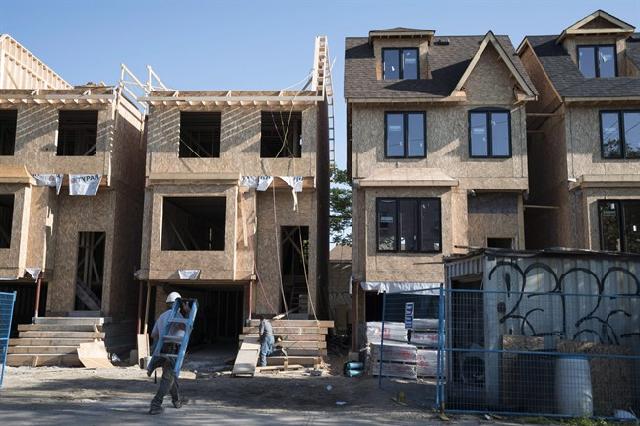
 TORONTO – Canada Mortgage and Housing Corp. says it has detected overvaluation in 11 housing markets, with other concerns flagged in Toronto, Winnipeg, Saskatoon and Regina.
Source: Overvaluation in 11 housing markets in Canada, CMHC report says

TORONTO – Canada Mortgage and Housing Corp. says it has detected overvaluation in 11 housing markets, with other concerns flagged in Toronto, Winnipeg, Saskatoon and Regina.
Source: Overvaluation in 11 housing markets in Canada, CMHC report says
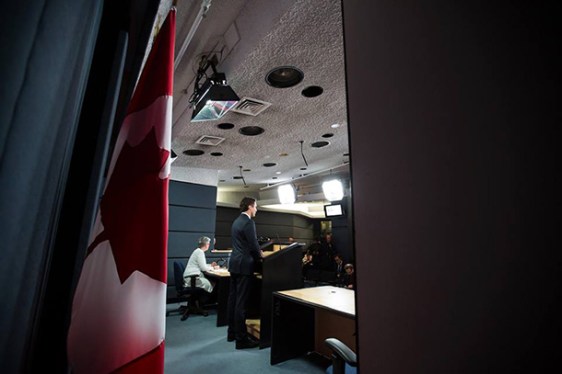 Surveying hazards and opportunities across our upended political landscape.
Matein Khalid http://www.khaleejtimes.com October 26, 2015
 The Canadian dollar’s strength may not last.(AFP)
So justin Pierre Trudeau is the new Premier Ministre of Canada. Stephen Harper’s decade in power as the Tory grand vizier in Ottawa was ultimately doomed by the oil shock, the commodities bust, the 2015 Canadian recession and voter discontent in Ontario, Quebec, Alberta and the Atlantic seaboard states. Even though Trudeau is the son of a political legend Pierre Trudeau, he has no economic or diplomatic policy making experience. Yet he will rule the first Liberal majority government in Ottawa since Jean Chretien in the late 1990s.
I can envisage higher public spending as Trudeau (and the electorate) does not share the Conservative Party’s commitment to a balanced budget or a Canadian combat role in the US led military coalition against Daesh in Iraq. This means tensions with Washington beyond the Keystone XL pipeline issue. Trudeau could even resurrect the ghost of his father’s Third Option in a world where China and Russia both challenge the US. All this reinforces my conviction, outlined in my October 12 KT column, that the Canadian dollar’s strength will not last.
So it did not surprise me that the loonie fell against 15 major currencies in Singapore trading the night Trudeau unseated Harper and entered the world stage. Once the Tories resorted to the xenophobic, anti-niqab campaign, I knew Harper had run out of ideas and political risk was going to rise in Canada even as oil prices and economic growth rates/mining capex fell. Trudeau’s C$60 billion infrastructure pledge (funded rise in deficits) and two shock Bank of Canada rate cuts, fiscal populism and higher US economic momentum means a lower loonie. So does the monetary policy divergence between the Yellen Fed and the Poloz Bank of Canada I expect will widen in 2016.
As a personal friend of former Liberal Prime Minister Jean Chretien and father of (a UAE dirham-financed) McGill undergrad, I will not disguise my pleasure at the election result and the softness of the Canadian dollar. Yet the free-fall in the Canadian dollar began in spring 2014 under the conservatives, when I recommended a loonie short at 1.06 (or 94 cents) against the US dollar.
Justin Trudeau will only add fiscal stimulus to Governor Poloz’s ultra-dovish monetary policies which have failed to use loonie depreciation to revive the Canadian economy. The yield on the 10-year Canadian Government bond is a miniscule 1.46 per cent at a time when Canada’s federal and provincial debt burden will only rise. In any case, the oil shock and $500 billion reserve falls in China will force sovereign wealth funds to jettison their holdings of Canadian government debt, which has historically been correlated with a rise in Federal budget deficits. A strategic put option on Canadian dollar government debt makes total sense since the yield on the 10-year Uncle Canuck note could well rise to two per cent or higher by late spring. Does Justin Trudeau’s proposed fiscal stimulus threaten Canada’s AAA credit rating? No.
Canada had the stablest banking system in the Western world in 2008 while Wall Street, the City of London and even the Bahnofstrasse/Paradeplatz went ballistic on subprime debt/credit derivatives. The commodity supercycle and China’s spectacular economic growth since 2001 was a financial windfall for Canada. Yet that was then and this is now. Canada is now in near recession, the commodities bust has just begun, epic consumer debt presages a housing crash, energy loans will gut banking profits and the loonie hit 12-year lows in September. Even though Alberta oil sands boast the world’s third-largest oil reserves, they are high-cost marginal producers who are toast during a global oil glut with no swing producer in either Riyadh or West Texas/North Dakota. Paradoxically, Harper’s “energy superpower” boast now haunts the loonie, since oil and gas is 25 per cent of Canadian exports. Other than the Norwegian kroner, the Canadian dollar is the ultimate Western world petrocurrency now, the political pendulum has shifted back from Alberta to the Liberal bastions of West Montreal.
Special Reports | Written by ActionForex.com | Oct 22 15 03:48 GMT
The BOC meeting turned out to be more dovish than expected. While leaving the overnight rate at 0.5%, the central bank trimmed its growth forecast for 2016 and 2017, and pushed backward the timing of the economy’s expected return to full capacity to mid-2017. Domestically, the BOC acknowledged that the economy has rebounded as projected in July. However, weakened dynamics in global growth should affect the country’s economic expansion which highly reliant on exports. Canadian dollar plunged more than -1% against US dollar. The loonie had strengthened against greenback over the past 3 weeks.
Policymakers acknowledged that global economic growth has been ‘a little weaker than expected this year’. Yet, they believed that the momentum pointing to a pickup in 2016 and 2017 remains ‘largely intact’. Regarding Canada’s largest trading partner, the US, the central bank noted that US’ economy is expected to ‘continue growing at a solid pace with particular strength in private domestic demand, which is important for Canadian exports’. On China, policymakers admitted that ‘uncertainty about China’s transition to a slower growth path has contributed to further downward pressure on prices for oil and other commodities’. We will discuss in the next paragraph that how the concerns over China have led to BOC’s downgrade of growth outlook.
Domestically, the BOC indicated that the economy ‘has rebounded, as projected in July’. For non-resource sectors, the ‘looked-for signs of strength are more evident, supported by the stimulative effects of previous monetary policy actions and past depreciation of the Canadian dollar’. What concerned policymakers the most is that a persistent decline in commodity prices would result in a downgrade to potential growth at least for the next year or two. As mentioned in the statement, the BOC noted that ‘lower prices for oil and other commodities since the summer have further lowered Canada’s terms of trade and are dampening business investment and exports in the resource sector’. This is the key reason for the central bank to downgrade its growth forecasts for 2016 and 2017. The Bank now projects real GDP will expand +1.1% in 2015, before accelerating to about +2% in 2016 and then +2.5% in 2017. The economy is now expected to return to full capacity, and inflation sustainably to target, around mid-2017.
On inflation, the BOC suggested that ‘total CPI inflation remains near the bottom of the Bank’s target range, owing to declines in consumer energy prices. Core inflation is close to +2% as the transitory effects of the past depreciation of the Canadian dollar are roughly offsetting disinflationary pressures from economic slack, which has increased this year. The Bank judges that the underlying trend in inflation continues to be about 1.5 to 1.7%’.
The BOC currently believes that the global economic slowdown and a rapid moderation in China’s growth might lend external support to Canada’s economic expansion. While the central bank now expects the economy to return to full capacity at around mid-2017, we see the potential for upside surprises after factoring in the planned increase in infrastructural spending by the newly election Liberal government.


 Andrew Phillip Chernoff