
May 17th is the International Day Against Homophobia and Transphobia 2014

Ten years ago, on May 17th homosexuality was removed from the International Classification of Diseases of the World Health Organization (WHO). This victory was a historic step towards recognizing freedom from discrimination based on sexual orientation and gender identity as a fundamental basic human right. Today the Canadian Labour Congress (CLC) stands in solidarity with the lesbian, gay, bisexual, trans and queer (LGBTQ) community in the struggle to end homophobia and transphobia.

Over the past ten years the movement to end homophobia and transphobia has gained strength.  Most recently, the struggle for protection from discrimination based on gender identity and gender expression has built momentum.  Many provinces and territories are either working on or have included gender identity and gender expressions in their human rights codes.  Ontario, Manitoba, Nova Scotia, Newfoundland, Prince Edward Island, and the Northwest Territories already include gender identity and gender expression as forbidden grounds for discrimination under their Human Rights Codes.  Bill C-279, which would amend the Human Rights Act to include gender identity is now awaiting a vote in the Senate.

We still have many challenges.

Despite the work that has been done to eliminate homophobia and transphobia, crimes and hatred against the LGBTQ community still exist at home and abroad. Over 76 countries around the world have deemed same-sex relationships illegal, and in some areas being a member of the LGBTQ community is still punishable by death (capital punishment). In Uganda, draconian anti-homophobic legislation has resulted in increased violence and murders of gay activists, individuals and allies. Russia’s law banning “homosexual propaganda”  has sparked an increase in homophobic violence.  The law even imposes fines for anyone providing information on homosexuality to minors and puts the children of same-sex families at risk. 

Even in Canada there are challenges to overcome. Despite the many gains in legislation and recognition for same-sex relationships and families, there is an increased backlash which puts these gains at risk.

Trinity Western University, a private Christian university in British Columbia is trying to establish a law degree program that would purposely exclude any student openly LGBTQ from graduating. The school has also asked its students to avoid homosexual sexual activities. Despite these clearly discriminatory policies, the new program has received preliminary approval from B.C.’s Ministry of Advanced Education, and from the Federation of Law Societies of Canada.

The Ontario English Catholic Teacher’s Association (OECTA) has faced considerable backlash for its decisions to support  Gay-Straight Alliances in schools and participate in Toronto’s World Pride parade. 

Teachers understand that LGBTQ students still face extreme cases of bullying which lead to dropping out of school, social isolation and, tragically, death and suicide.  According to OECTA’s President, James Ryan, “OECTA believes that taking the public stand of marching in the WorldPride Parade 2014 will provide comfort and support to our students and teachers who frequently struggle in a hostile environment that does not offer them the support and protection they are owed as citizens of Ontario and Canada”. The Canadian Labour Congress commends the dedicated teachers and students who fight these injustices everyday by forming Gay Straight Alliances, safe spaces, who teach anti-bullying and promote acceptance of all gender identities in the school.

Canada’s labour movement will continue to fight for fairness and equality for our LGBTQ members and their loved ones―in the workplace and in the broader community. We are committed to continuing the fight for workplace legislation against violence and bullying, as well as federal legislation and stronger collective agreement language for LGBTQ people. The CLC will continue to work with our allies to mobilize the Senate to pass Bill C-279 for trans people to have full rights under Canada’s Criminal Code and the Canadian Human Rights Act.

Together, we will end homophobic and transphobic discrimination in our workplaces and communities.
More on Demographics, Demand, and Canada’s Falling Employment Rate

Posted by Jim Stanford May 11th, 2014   http://www.progressive-economics.ca

My post last week on the continuing decline in the employment rate in Canada (to below 61.5% in April, barely higher than the low point reached in the 2008-09 recession) has sparked some continuing discussion about the role of demographic change in explaining that decline (as opposed to a shortage of labour demand).

Is the decline in the employment rate due to weak labour market conditions, or is it due to the ageing of the workforce (as a result of which a larger share of the working age population consists of people in older age categories which normally have lower labour force participation and employment incidence)?

The answer, obviously, is “Both.”  The ageing of the Canadian workforce is a decades-old trend, it did not start in February 2008 (when the overall employment rate peaked at 63.8%).  Until then, the ageing of the workforce did not prevent the overall labour market from enjoying higher employment rates over time.  The downturn in the business cycle did start in 2008.  So it’s reasonable to conclude that this turn likely reflects cyclical (not structural) factors.

We can try to sort out the two forces at play by disaggregating the employment rate numbers by age category.  My methodology in analyzing the overall decline in the employment rate was to compare today’s rate to the pre-recession peak, and then estimate how much more employment would be required to get back to that pre-recession employment rate.  I interpreted that as a broad measure of the amount of new employment required to truly repair the damage from the recession.  That approach is certainly more reasonable than the argument made by the federal government that since absolute employment today is higher than it was before the recession, all the damage done by the recession has been repaired; this argument ignores 6 years of population growth which added over 2 million Canadians to the working age population.

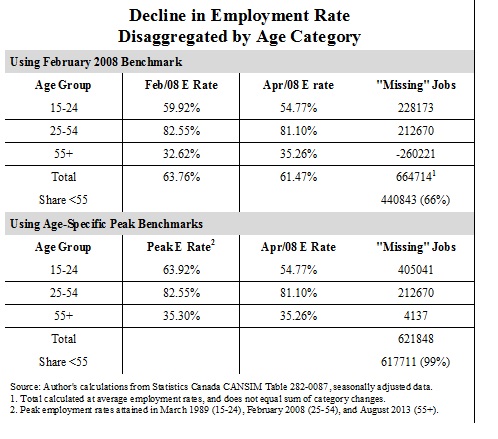
Now let’s replicate my analysis, but disaggregating the employment rate data into broad age categories.  Young workers (15-24) have experienced the worst decline in employment incidence.  So-called “core” workers (25-54) have experienced a more modest decline.  Older workers (55 and over) have experienced a higher employment rate.  Whether this is good or bad depends on how many of these older workers are choosing to work longer for positive reasons, and how many have been compelled to stay in their jobs by reduced or less secure pension incomes.

Decline in Employment Rate

The first part of this table shows that for the two under-55 categories, a total of 441,000 additional jobs would be required to rebuild the two under-55 employment rates back to their respective February 2008 levels.  That represents two-thirds of the total 665,000 missing jobs I had estimated on the basis of the analysis of the aggregate 15+ employment rate.  (Because of the shift-share phenomena discussed above, the total “missing” jobs does not equal the sum of the age category “missing” jobs.)  In other words, two-thirds of the deterioration in the overall employment rate since 2008 can be ascribed to the deterioration of employment incidence among under-55 workers — and hence can’t be directly attributed to demographic change.  Perhaps the rest of the 665,000 jobs could be attributed to demographic ageing, offset somewhat by the rising employment incidence among the 55+ category.

Another approach, that would more closely replicate the spirit of my aggregate analysis, would be to separately locate the peak employment rate experienced within each age category, rather than using the peak employment rate for the aggregate 15+ labour force (which was February 2008).  After all, if we’re going to disaggregate current employment performance by age group, we may well wish to also disaggregate the parallel task of measuring the extent to which current employment falls below peak (or potential) employment incidence.  This exercise is summarized in the lower part of the table.

The peak employment rate for the “core” 25-54 age group was attained in February 2008, so there is no difference for that group.  The peak employment rate for young workers was attained back in 1989 (the employment rate for young workers in 2008 was still almost 4 percentage points below that peak, reflecting both higher youth unemployment in 2008 than 1989 and lower labour force participation, presumably due mostly to higher participation in post-secondary education — although PSE enrollment itself partly reflects weak employment opportunities).  The peak employment rate for the over-55 group was attained in August last year; even in this group the employment rate has declined in recent months.

Comparing the actual employment rate to the historical peak rate within each category, leads to a combined estimate of “missing” jobs of 622,000 positions — almost all of which were borne by the two under-55 age groupings (since older workers are experiencing close-to-peak employment rates).  That’s not hugely different from the 665,000 missing-job estimate I derived on the basis of the overall population.  The takeaway from this analysis: Even adjusting for the ageing of Canada’s workforce, the economy would need a total of 622,000 more jobs to bring up the employment rate (for each age category of worker) to its potential (based on peak attained employment rates).

I certainly accept that demographic change is part of the story of Canada’s falling employment rate.  That being said, however, I think the following take-away conclusions are valid:

  • The decline in the employment rate is due more to weak employment demand than to demographic change.

  • The decline in the employment rate is clearly visible in young and core workers.
  • Employment in Canada among workers under 55 is hundreds of thousands positions (from 441,000 to 618,000, depending on your choice of benchmark) below what it would be if previous peak balances between workers and jobs were re-attained today.
  • And since the pre-recession benchmark was not itself a position of full employment, the true problem of underutilization of labour in Canada is even greater.

Labour force participation among under-55 workers has also declined significantly (this is not reported in the table), and so far in 2014 has averaged its lowest levels in both age groups (15-24 and 25-54) since 2002.  Overall labour force participation (among all people 15+) is at its lowest level since 2001.  So the decline in labour force participation (like the decline in the employment rate) is mostly due to factors other than demographics (presumably, weak labour demand).

The phenomenon of rising participation and employment among older workers is an important one that needs lots more analysis.  Indeed, it is trickling over into the decline in employment rates among the youth and core age groups.  In a demand-constrained labour market, younger workers always bear a disproportionate share of the burden of un- and underemployment (reflecting last-hired first-fired effects, etc.).  Therefore, while much of the decline in employment incidence among under-55 workers reflects weak overall labour demand, some of it also reflects a redistribution of employment from younger to older workers.  This is a perverse result for many economic and social reasons, and should lead us to question policies (like postponing the retirement age to 67, and other restrictions on early retirement) which are helping push up employment rates among older workers.

Want to buy your way into Canada? New options revealed

By Majorie van Leijen    May 13 2014   https://www.zawya.com

Want to buy your way into Canada? New options revealed

Photo Credit:REUTERS/David McNew

New investment programme in Canada in the making

In February this year, the two investment programmes that existed were scrapped by the Canadian government, along with the backlog of thousands of applications. What had been the gateway to Canadian citizenship for the high net-worth-individuals for many years was suddenly a closed door.

However, it seems that the door will not remain shut, as several options have already been discussed. Most concrete were recent statements made by Chris Alexander, Minister of Immigration and Citizenship, to the Chinese media about the details of a new investment pilot scheme, which is set to be launched by the year-end.

According to news sources, the new programme would take the shape of a venture capital pilot, with a minimum investment amount that is more than twice as much as the previous amount, which was CAD800,000.

The investment would involve a privately managed at-risk venture capitalist investment, with a strong focus on start-up businesses, whereas the original programme offered a risk-free investment; the funds were eventually returned in full, interest free. The financing option that existed would no longer be part of the new pilot.

Further, the period of investment would probably exceed the previous investment period, which was a five-year period. However, language and residency requirements would most likely not be terribly stringent.

When the Immigrant Investment Programme (FIIP) and the Entrepreneur Programme were cancelled three months ago, the Citizenship and Immigration Canada (CIC) explained that in order to move forward with programmes that would more accurately capture the types of investors needed in Canada, CIC would instead eliminate the files currently in the backlog.

With that decision, 65,000 backlogged applications were returned. “By doing away with the current IIP and EN programmes, the government will pave the way for new pilot programmes that will actually meet Canada’s labour market and economic needs,” was the argument of the CIC.

However, not much was revealed about these programmes after that, claimed Sergio Marchi, former Minister of Citizenship & Immigration and Member of the global Council on Migration at the sidelines of the Citizenship by Investment & International Residence Summit, held in Dubai last month.

“Rather than refocusing and reinvigorating the programme, it was terminated without providing the public with a transparent economic analysis of the costs and benefits it brought to Canada,” he said.

Over the last 25 years, some 3,000 high net-worth-individuals have become residents annually, representing over CAD10 billion of investments, he points out. “These investments have been used to fund Canadian priorities, including support for SMEs and debt reduction.”

In general, the focus of the Canadian immigration policy has been more on the worker than on the investor. On average, immigrant investors comprised between 2-3 per cent of all immigrants who come into Canada each year, and a total of 130,000 investors have arrived in Canada over the past 25 years.

Ironically, the country was among the first to adopt an immigrant investment programmes, a concept which has been applied in many countries ever since. However, there is currently only the Start-Up Programme, which is an option for the entrepreneur to do business in Canada in return for permanent residency.

© Emirates 24|7 2014

The Conservative economic record: 665,000 missing jobs

May 9, 2014 by PressProgress

Employers eliminated 30,900 full-time jobs last month and 25,600 Canadians left the labour force altogether, Statistics Canada job numbers released Friday show.

With an increase of just 2,000 part-time jobs for a net loss of 28,900 jobs, Erin Weir, an economist with United Steelworkers, puts the bad news in context.

“This large decline in employment coincided with an increase of 41,000 in Canada’s working-age population. The employment rate, the proportion of working-age Canadians who are employed or self-employed, fell to 61.5% – its lowest level since March 2010,” Weir said in a statement.

In other words, if the employment rate was back at its pre-recession peak (63.8%), Canada would have 665,000 more jobs today. “Damage of recession has not been repaired,” tweeted Jim Stanford, an economist with Unifor. 

Instead, Canada’s employment rate of 61.5% is now only 0.2 points above July 2009, the trough of the recession. “Employment rate has been steadily eroding since late 2012. Cda’s recovery has no engine, no momentum – thanks, austerity,” added Stanford.

Meanwhile, Douglas Porter, chief economist with the Bank of Montreal, told the Canadian Press that “there’s no question this was a bit of a disappointment. It continues a trend we’ve seen over the last six months of down then up, and up then down. So we’re seeing a see-saw action in Canadian employment.”

Here’s what that looks like, courtesy of Unifor:

Job number - May 2014

UN tells feds to consult before approving B.C. coast pipelines

Report by James Anaya, the UN’s special rapporteur, says there’s a ‘crisis’ in Canada

By Peter O’Neil, Vancouver Sun May 12, 2014

UN tells feds to consult before approving B.C. coast pipelines

A report by James Anaya, the UN’s special rapporteur on the rights of indigenous peoples (pictured), said there is a “crisis” in Canada and that the level of mistrust has perhaps worsened in the past decade.     Photograph by: Sean Kilpatrick , The Canadian Press

OTTAWA — The Harper government must ensure there is “free, prior and informed consent” from First Nations before giving the go-ahead to major resource projects – including two proposed pipeline megaprojects to the B.C. coast, the United Nations said Monday.

A report by James Anaya, the UN’s outgoing Special Rapporteur on the Rights of Indigenous Peoples, said there is a “crisis” in Canada and that the level of mistrust has perhaps worsened since the last visit by a UN representative just over a decade ago.

Anaya put the two oil sands pipeline megaprojects – Enbridge’s to Kitimat and Kinder Morgan Canada’s to Burnaby – at the top of a long list of economic initiatives that have drawn bitter complaints from aboriginal leaders Anaya met during a fact-finding mission last year.

Anaya, an American indigenous rights scholar and nominee for the 2014 Nobel Peace Prize, said the government doesn’t have a coherent plan to meet its Supreme Court of Canada-mandated obligations to consult and accommodate First Nations before major projects proceed.

“There appears to be a lack of a consistent framework or policy for the implementation of this duty to consult, which is contributing to an atmosphere of contentiousness and mistrust that is conducive neither to beneficial economic development nor social peace,” Anaya wrote.

One of his recommendations calls on the federal government to set a clear policy on consultation and accommodation.

“In accordance with the Canadian constitution and relevant international human rights standards, as a general rule resource extraction should not occur on lands subject to aboriginal claims without adequate consultations with, and the free, prior and informed consent of, the indigenous peoples concerned,” stated Anaya in his report that was released in Geneva Monday.

In a Vancouver Sun interview Monday Anaya said “free, prior and informed consent,” a term used in the 2007 UN Declaration on the Rights of Indigenous Peoples, doesn’t mean there should be an Aboriginal veto on resource projects.

But he said said the commitment in the declaration, which Canada endorsed 2010, does require governments to engage in genuine consultation to ensure Aboriginal rights are protected, and to consider killing projects when accommodation can’t be reached.

The report also lists the Site C hydroelectric dam project on the Peace River, gas drilling and pipeline construction in northeastern B.C. on Treaty 8 nations’ traditional territory, and the attempts by Taseko Mines and Fortune Minerals to build mines on unceded traditional First Nations territory in B.C.

The report criticized the federal environmental review panels, saying the panelists are perceived by First Nations as having “little understanding of aboriginal rights jurisprudence or concepts.”

Anaya had a number of other tough criticisms:

– He called on the Harper to reverse his position and call for a “comprehensive, nation-wide inquiry into the issue of missing and murdered aboriginal woman and girls, organized in consultation with indigenous peoples.”

– He sharply criticized the federal government over its handing of land claims across Canada and especially in B.C., where many First Nations are deeply in debt and utterly frustrated over federal negotiating tactics.

But Anaya also found some positive developments, including the agreement late last year to establish a B.C. First Nations Health Authority. He called that a potential model for other jurisdictions.

Aboriginal Affairs Minister Bernard Valcourt cited in a statement Monday the report’s complimentary references to Canada’s track record in protecting Aboriginal peoples’ rights.

“The report published by the Special Rapporteur today acknowledges that, while many challenges remain, many positive steps have been taken by the Government of Canada to improve the overall well-being and prosperity of Aboriginal people in Canada.

He also said resource projects should be seen in a positive light.