UPDATE 1-Canada court orders tobacco giants to set aside almost C$1 bln | Reuters

A Canadian appeal court on Tuesday ordered two major tobacco companies to set aside a combined C$984 million ($742 million) while they challenge billions of dollars in damages awarded to smokers in the province of Quebec.

Source: UPDATE 1-Canada court orders tobacco giants to set aside almost C$1 bln | Reuters

It it ethical to take union-won benefits without joining?

Some U.S. states say people should have the right not to join a union

By: Ken Gallinger Ethically speaking columnist, Published on Fri Jun 13 2014

http://www.thestar.com

Many American states permit employees in unionized worksites to opt out of dues. It’s not legal in Canada. But after Michigan passed such a law, some conservative politicians began promoting the idea here. The argument made by proponents is “the right of employees to decide for themselves whether or not to join a union.” Is it ethical to refuse to pay dues if you work in a job covered by a union contract?

There are two viable ways of paying for services we enjoy. On the one hand, there are a limited number of services (roads, police, hospitals etc.) that we all pay for, whether we use them or not. These are provided by government, and deemed to some degree essential.

The vast majority of services on which we depend, however, are to some extent user-pay — i.e., if you use the service, you pay some of the cost. Included on the long list of services we fund on a per-use (or per-season, etc.) basis are things like provincial parks, museums, public transit, theatre tickets, etc. Almost all of these enjoy some public subsidization, because we are still, essentially, a socialist country. But users pay some per-pop cost, and in recent years the percentage has generally shifted away from subsidies, and towards higher user fees. Even in education, parents report a never-ending chorus of gimme from schools their kids attend.

Proponents of so-called “Right to Work” legislation (a euphemism gone malignant if there ever was one) argue, on the one hand, that union membership/dues should be a discretionary, user-pay arrangement; those who choose to support unions would be free to do so, but others equally free to opt out. Where their logic goes weirdly off track, however, is on the question of whether those who opt out of dues would also relinquish the benefits won by unions, not only on that particular worksite, but across society. Well, no, they wouldn’t in fact; they would continue to receive all the benefits of union negotiations, advocacy and so on — either without paying a cent, or in return for a paltry fee-for-service. That’s why Rick Unger, writing in Forbes, said this would be better described as “Right to Freeload” legislation.

The question is not whether everyone in society should be legally required to pay union dues; I’ve never paid dues in my life — but I’ve also never enjoyed the protections that workers in unionized environments take for granted. If I had a dispute with my employer, I was completely, 100 per cent on my own.

The real question is: could it ever be OK to accept work in a context where employees enjoy salary levels, pension plans, working conditions and other benefits that have been won, over many years, by unions, and still not support the unions that won those benefits?

The obvious answer is “no.”

Unless we create a society where worker’s rights, pensions and other benefits are universally protected by government — and we’re all prepared to pay for that protection the same way we pay for cops and hospitals — unions remain the only effective vehicle by which those benefits are won and protected. And ethically speaking, if you dance the jig, you pay the piper.

Internet users’ privacy upheld by Canada’s top court

Internet providers can’t provide customer names and addresses to police without a warrant

CBC News  Jun 13, 2014

Canadians have the right to be anonymous on the internet, and police must obtain a warrant to uncover their identities, Canada’s top court has ruled.

The landmark decision from the Supreme Court Friday bars internet service providers from disclosing the names, addresses and phone numbers of their customers to law enforcement officials voluntarily in response to a simple request — something ISPs have been doing hundreds of thousands of times a year.

It also means parts of the cyberbullying and digital privacy bills that are currently before the House of Commons may be unconstitutional.

Friday’s decision concerned the case of Matthew David Spencer, of Saskatchewan, who was charged in 2007 and convicted of possession of child pornography after a police officer saw illegal files being downloaded to his IP address — a series of numbers representing the internet identity of a device such as a computer.

The police officer went to Spencer’s internet service provider (ISP), Shaw, and asked for the real identity of the customer attached to the IP address. The police officer did not have a search warrant, but was given subscriber information for Spencer’s sister, allowing police to track him down. 

Spencer appealed his conviction, arguing that the search was unconstitutional and his rights were violated.

The Saskatchewan Court of Appeal ruled there is no reasonable expectation of privacy for basic internet subscriber information, prompting Spencer to appeal to the Supreme Court of Canada.

The Supreme Court disagreed that there is no reasonable expectation of privacy for the data obtained by police.

“In my view, in the totality of the circumstances of this case, there is a reasonable expectation of privacy in the subscriber information,” Supreme Court Justice Thomas Cromwell wrote.

“The disclosure of this information will often amount to the identification of a user with intimate or sensitive activities being carried out online, usually on the understanding that these activities would be anonymous.”

Warrantless search ‘unreasonable’

He added, “A warrantless search, such as the one that occurred in this case, is presumptively unreasonable. The Crown bears the burden of rebutting this presumption.”

Although the Supreme Court set limits on when internet providers can disclose customer information, it dismissed Spencer’s appeal.

computer

The Supreme Court of Canada says in a decision released Friday that internet users have a right to privacy pending a search warrant. (Shutterstock )

It said police should have obtained a warrant before asking Shaw for the customer information. But it also said police acted reasonably and in good faith, so the administration of justice would be impaired if the evidence gathered by searching Spencer’s home in this particular case were thrown out of court.

The top court decision means Spencer would be subjected to a new trial, on a charge of making child pornography available to others.

The Canadian Civil Liberties Association said in a statement that the Supreme Court decision clarifies “a point of long-standing disagreement between privacy advocates and law enforcement authorities” – whether Canada’s Personal Information Protection and Electronic Documents Act allows police to obtain subscriber information without a warrant. The act governs how the private sector gathers and handles personal information. 

The Supreme Court’s ruling that a warrant is required “confirms CCLA’s view that PIPEDA is legislation to protect privacy, and cannot be used to undermine it,” the association said.

The CCLA launched a challenge in May to have parts of PIPEDA declared unconstitutional. It said the new Supreme Court decision may play a “significant role” in the challenge.

‘Huge victory for internet privacy’

Michael Geist, a professor of internet law at the University of Ottawa, called the Supreme Court decision a “huge victory for internet privacy.”

The decision means that the common police practice of obtaining information about customers from internet service providers simply by asking for it must stop, he wrote in a blog post Friday.

“This means ISPs must change their practices on voluntary, warrantless disclosure,” he added.

The decision could also affect two federal government bills, rendering parts of them unconstitutional:

  • Bill C-13, which is intended to crack down on cyberbullying, but includes provisions that would give police easier access to the metadata that internet service providers and phone companies keep on every call and email from their customers.
  • Bill S-4, to be known as the digital privacy act, would update the Personal Information Protection and Electronic Documents Act that governs how the private sector handles private information. It includes provisions that also make it easier for police to obtain basic subscriber information without a warrant.

Government reviewing decision

The government is reviewing the decision, said Bob Dechert, parliamentary secretary to Justice Minister Peter MacKay during question period Friday.

“In addition,” he said, “we’ll continue to crack down on cyberbullies and online criminals who work against and make our children and all Canadians unsafe.”

A spokesperson for Industry Minister James Moore, who introduced the digital privacy act bill in April,  told CBC News that his office is also reviewing the Supreme Court decision.

Meanwhile, opposition MPs said the ruling was no surprise.

NDP House leader Peter Julian said, also during question period, that the NDP and privacy experts had warned the government all along. 

“And yet Conservatives are steamrolling ahead with Bill C-13, which also allows unconstitutional spying on Canadians,” he said. “When will they finally take a balanced approach that keeps Canadians secure without infringing on constitutional rights?”

Recent reports show that law enforcement and government agencies have been routinely asking Canadian telecommunications companies for information about hundreds of thousands of their subscribers each year without a warrant.

Rogers Communications released a report last week showing that it received almost 175,000 requests for information about its customers from government and police agencies last year.

In March, the Chronicle Herald newspaper in Halifax reported the Canada Border Services Agency alone accessed telecom customer data almost 19,000 times in one year — and without a warrant more than 99 per cent of the time.

In 2011, the Canadian Wireless Telecommunications Association reported to Canada’s privacy commissioner its members received 1.2 million requests for customer information in one year and disclosed information about 780,000 customers. 

SURETTE: Harper could still hang on, even after defacing Canada

http://thechronicleherald.ca     ralph Surette    May 16, 2014

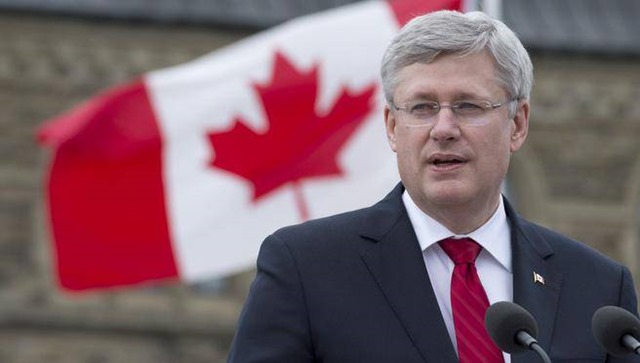
B97319909Z.120140516151800000GUH5J504.11           Three little-tent parties suit Stephen Harper just fine, because small, dirty and divided is his game, writes Ralph Surette. (ADRIAN WYLD / CP)

Watching Stephen Harper envenom not only the politics of the day but hammer at our deepest societal framework — the rule of law, democratic process — is to wonder what will be left of our self-respect as a nation if he wins the next election, thanks to a splintered electorate.

Once the light of the world on many fronts, Canada is now denounced regularly on environment, foreign aid and other things. Germany’s Bertelsmann Foundation, which rates governments every three years, has Canada slipping fast in “good government” ratings. Of the “high-quality governance structures” Canada once had in place, it said in its most recent report, “the actions of the Canadian government . . . have jeopardized this situation.”

Harper is a genius at totalitarian-style manipulation that feeds on the divisions that it has itself created, and at keeping the public confused. The fact that his party is still in the game at all according to the polls, despite one anti-democratic binge after another, attests to that.

Despite everything, he comes out with only a few light scratches over his scandalous attack on Supreme Court Chief Justice Beverley McLachlin on a trumped-up accusation.

This is not just a nasty spat. The Harperists have been attacking the courts from Day 1, and their problem is not with this or that judge — it is with the rule of law itself. The PMO’s reported fury at a string of setbacks suffered at the hands of the Supreme Court tells us ever more clearly that the Conservatives see the law as their plaything, to be bent to their purposes.

Harper is a clear-headed ideologue — all the more dangerous for that. Having bragged to the effect that “you won’t recognize Canada after I’m through with it,” his stated goal is to destroy the Liberal party and turn his own into the “natural governing party.”

The time for natural governing parties is probably over, but he can take some satisfaction in the reduced state of the Liberal party. The Harperists’ one telling argument is that Justin Trudeau “is not ready for prime time.” As regularly as Harper assaults democracy, Trudeau puts his foot in his mouth. And the recent signal given by its exclusion of pro-life candidates on the abortion issue is that the Liberal party is no longer a “big-tent” party. Three little-tent parties suit Harper fine, because small, dirty and divided is his game.

One would hope that by the time the next election rolls around in a year and a half, the game will be absolutely clear to the electorate. The idea of Harper in power another four years to rip up treaties, pervert the electoral process, pass manipulative omnibus bills, deepen the hold of oil and other resource companies over government, rig the tax system for partisan purposes, politicize the bureaucracy, plus attack environmentalists, scientists, civil society groups and parliamentary watchdogs, among others, should give us pause indeed.

Actually, many people get it now — the Harperists linger at some 20 per cent in the polls in Atlantic Canada and at 13 per cent in Quebec, raising the prospects of election night opening with fewer than a half dozen Conservative seats east of Ontario, and maybe none at all. The Prairies won’t budge much, despite some Conservative libertarians objecting to Harper’s iron grip, leaving Ontario and B.C. to decide. There, the Harperists are behind the Liberals, but not by much.

Harper’s argument there is that he’s going to heroically balance the budget and cut taxes. That is, he’s going to slash at everything, like services to veterans, and, especially, dump costs on the provinces. (Even the Parliamentary Budget Officer doesn’t know what exactly is being cut — that’s hidden in the last omnibus bill.)

With these savings, he’ll propose to cut taxes aimed at key voting groups in the money belts around Toronto and Vancouver that can be counted on to put self-interest above country.

If only Canadians saw what the outside sees. Once the light of the world on many fronts, Canada is now denounced regularly on environment, foreign aid and other things. Germany’s Bertelsmann Foundation, which rates governments every three years, has Canada slipping fast in “good government” ratings. Of the “high-quality governance structures” Canada once had in place, it said in its most recent report, “the actions of the Canadian government . . . have jeopardized this situation.”

Meanwhile, last November, with the media saturated with the Senate and Rob Ford scandals, Canadians heard nothing of the thrashing we got at the Warsaw Climate Change Conference, where several studies put us down with Saudi Arabia, which flares off oilfield gas, and a couple of others as one of the dirtiest nations on Earth per capita, thanks mostly to the tar sands.

Meanwhile, the opposition Liberals and NDP, which two-thirds of the electorate would like to see come together to put an end to Harper, instead are locked in their own frenzied combat, making it more likely that the Conservatives will slip through in those contested areas. And another Harper victory, even in a squeaky minority, would kill any chance that this country can retake its place as a positive force in the world.

Harper is a genius at totalitarian-style manipulation that feeds on the divisions that it has itself created, and at keeping the public confused. The fact that his party is still in the game at all according to the polls, despite one anti-democratic binge after another, attests to that.

About the Author

ralph Surette

Ralph Surette is a freelance journalist in Yarmouth County.

E-Mail: rsurette@herald.ca