Drop in consumer confidence continues – personal finances slide (released February 1, 2016)

Bloomberg-Nanos Economic Banner

Bloomberg Nanos Weekly Consumer Confidence Tracking

The negative trend in consumer confidence continues in Canada on multiple fronts.  The Prairies have hit yet another low in confidence, and positive sentiment on personal finances realized a noticeable one week drop.

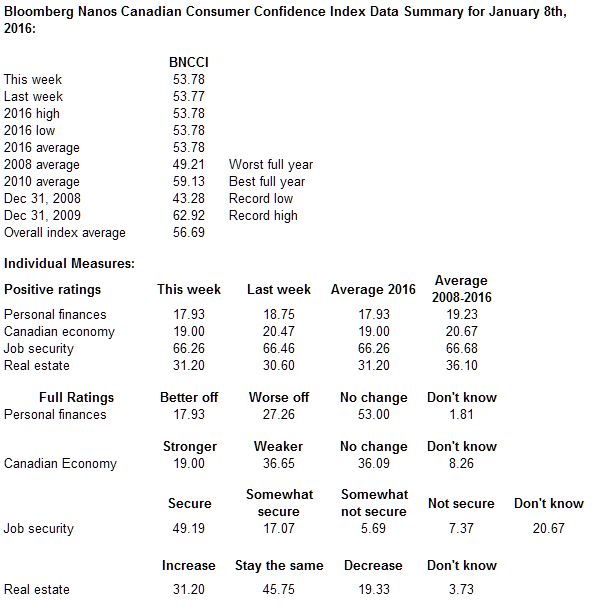
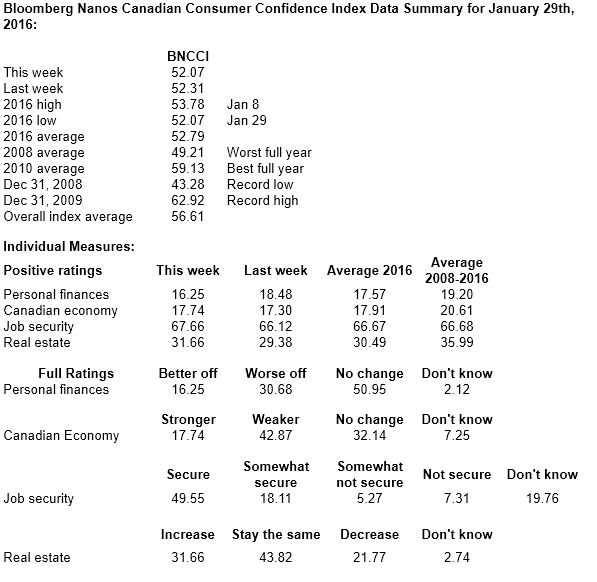
“Canadian economic sentiment continues to dampen with only 18 per cent of Canadians saying they expect the Canadian economy will get stronger in the next six months compared to 43 per cent who believe the economy will get weaker,” said Nanos Research Group Chairman Nik Nanos.

“As last fall’s election suggests, we could anticipate an improvement in consumer sentiment if and when a fiscal stimulus becomes apparent. In the meantime, consumers are contending with wage growth that remains substantially below long-term averages and employment prospects that have been deteriorating for the past 12 months”, said Robert Lawrie of Bloomberg Economics.

The BNCCI, a composite of a weekly measure of financial health and economic expectations, registered at 52.07 compared with last week’s 52.31. The twelve month high stands at 58.62.

The Bloomberg Nanos Pocketbook Index is based on survey responses to questions on personal finances and job security. This sub-indice was at 57.95 this week compared to 59.18 the previous week. The Bloomberg Nanos Expectations Index, based on surveys for the outlook for the economy and real estate prices, was at 46.19 this week (compared to 45.45 last week).

The average for the BNCCI since 2008 has been 56.61 with a low of 43.28 in December 2008 and a high of 62.92 in December 2009. The index has averaged 52.79 this year.

To view the weekly tracking visit our website.

Methodology

The BNCCI is produced by the Nanos Research Corporation, headquartered in Canada,  which operates in Canada and the United States.  The data is based on random telephone interviews with 1,000 Canadian consumers (land- and cell-lines), using a four week rolling average of 250 respondents each week, 18 years of age and over. The random sample of 1,000 respondents may be weighted by age and gender using the latest census information for Canada and the sample is geographically stratified to be representative of Canada. The interviews are compiled into a four week rolling average of 1,000 interviews where each week, the oldest group of 250 interviews is dropped and a new group of 250 interviews is added. The views of 1,000 respondents are compiled into a diffusion index from 0 to 100. A score of 50 on the diffusion index indicates that positive and negative views are a wash while scores above 50 suggest net positive views, while those below 50 suggest net negative views in terms of the economic mood of Canadians.

A random telephone survey of 1,000 consumers in Canada is accurate 3.1 percentage points, plus or minus, 19 times out of 20.

All references or use of this data must cite Bloomberg Nanos as the source.
screenshot-{domain} {date} {time}

Consumer confidence in Canada continues to decline for tenth week in succession – Expectations near Great Recession low (released January 25, 2016)

Bloomberg-Nanos Economic Banner

Bloomberg Nanos Weekly Consumer Confidence Tracking

Overall consumer confidence in Canada continues to decline in the face of a lower dollar and the price in a barrel of oil.  The forward looking Expectations Sub-indice remains net negative and is near a low equivalent to one registered during the Great Recession in 2008.

“The negative sentiment in both Ontario and Alberta are significant in terms of the overall mood of the economy and potential knock-on effects on consumer spending,” said Nanos Research Group Chairman Nik Nanos.

“The Bank of Canada saw enough continuing slack in the economy to consider additional monetary easing, citing the impact of dislocations in the resource sector on the rest of the economy. Private forecasts are calling for sub-2% real GDP growth until the third quarter of 2016, with the success of a fiscal response and the U.S. recovery likely to play a key role in determining household balance sheets”, said Robert Lawrie of Bloomberg Economics.

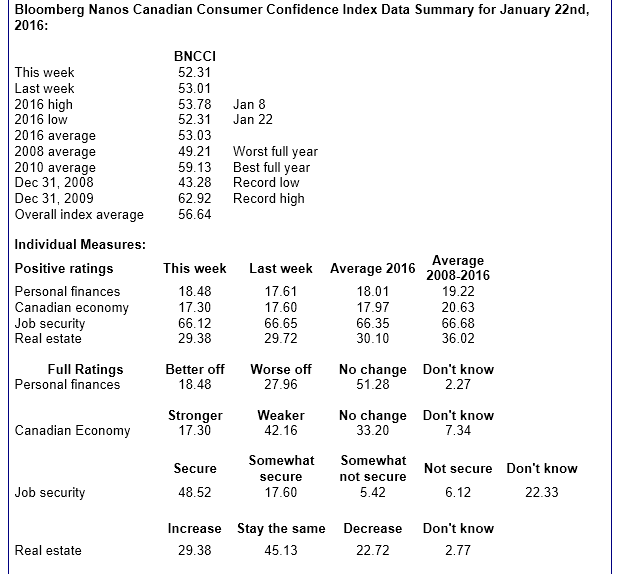
The BNCCI, a composite of a weekly measure of financial health and economic expectations, registered at 52.31 compared with last week’s 53.01. The twelve month high stands at 58.62.

The Bloomberg Nanos Pocketbook Index is based on survey responses to questions on personal finances and job security. This sub-indice was at 59.18 this week compared to 58.99 the previous week. The Bloomberg Nanos Expectations Index, based on surveys for the outlook for the economy and real estate prices, was at 45.45 this week (compared to 47.02 last week).

The average for the BNCCI since 2008 has been 56.64 with a low of 43.28 in December 2008 and a high of 62.92 in December 2009. The index has averaged 53.03 this year.

To view the weekly tracking visit our website.

Methodology

The BNCCI is produced by the Nanos Research Corporation, headquartered in Canada,  which operates in Canada and the United States.  The data is based on random telephone interviews with 1,000 Canadian consumers (land- and cell-lines), using a four week rolling average of 250 respondents each week, 18 years of age and over. The random sample of 1,000 respondents may be weighted by age and gender using the latest census information for Canada and the sample is geographically stratified to be representative of Canada. The interviews are compiled into a four week rolling average of 1,000 interviews where each week, the oldest group of 250 interviews is dropped and a new group of 250 interviews is added. The views of 1,000 respondents are compiled into a diffusion index from 0 to 100. A score of 50 on the diffusion index indicates that positive and negative views are a wash while scores above 50 suggest net positive views, while those below 50 suggest net negative views in terms of the economic mood of Canadians.

A random telephone survey of 1,000 consumers in Canada is accurate 3.1 percentage points, plus or minus, 19 times out of 20.

All references or use of this data must cite Bloomberg Nanos as the source.

screenshot-{domain} {date} {time}

Views on real estate and future strength of the economy slide in confidence tracking – Ontario now hits a new 12 month low (released January 18, 2016)

Bloomberg-Nanos Economic Banner

Bloomberg Nanos Weekly Consumer Confidence Tracking

The slide in consumer confidence continued. The energy rich Prairie continue to be the most pessimistic.  Of note, Ontario has now hit a 12 month low for that province on the Bloomberg Nanos Canadian Confidence Index although still comparatively higher than the Prairies.

“A slide in consumer confidence in Ontario, coupled with the erosion of confidence in the energy rich Prairie province represents a one-two punch on the consumer confidence in Canada,” said Nanos Research Group Chairman Nik Nanos.

“Households are contending with higher out-of-pocket expenses as a weakening Canadian dollar raises the costs for consumer staples. This immediate impact on private consumption is a concern in light of surveys suggesting a decline in the demand for bank lending and a decline in business sentiment, whose impacts are generally felt in coming quarters”, said Robert Lawrie of Bloomberg Economics.

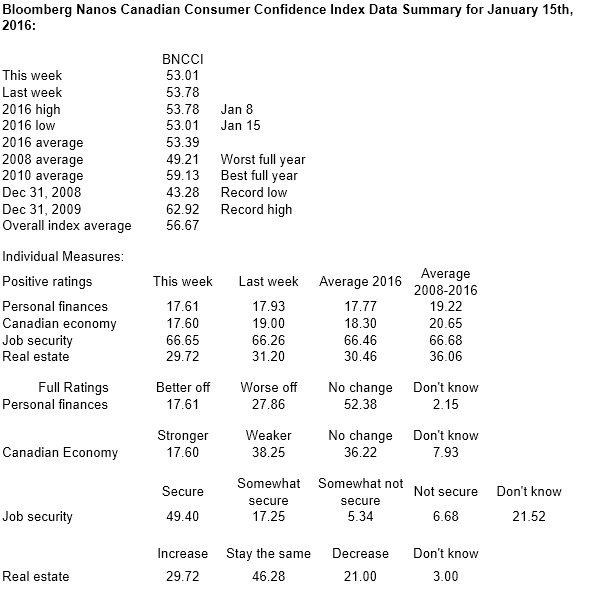
The BNCCI, a composite of a weekly measure of financial health and economic expectations, registered at 53.01 compared with last week’s 53.78. The twelve month high stands at 58.62.

The Bloomberg Nanos Pocketbook Index is based on survey responses to questions on personal finances and job security. This sub-indice was at 58.99 this week compared to 59.00 the previous week. The Bloomberg Nanos Expectations Index, based on surveys for the outlook for the economy and real estate prices, was at 47.02 this week (compared to 48.56 last week).

The average for the BNCCI since 2008 has been 56.67 with a low of 43.28 in December 2008 and a high of 62.92 in December 2009. The index has averaged 53.01 this year.

To view the weekly tracking visit our website.

Methodology

The BNCCI is produced by the Nanos Research Corporation, headquartered in Canada,  which operates in Canada and the United States.  The data is based on random telephone interviews with 1,000 Canadian consumers (land- and cell-lines), using a four week rolling average of 250 respondents each week, 18 years of age and over. The random sample of 1,000 respondents may be weighted by age and gender using the latest census information for Canada and the sample is geographically stratified to be representative of Canada. The interviews are compiled into a four week rolling average of 1,000 interviews where each week, the oldest group of 250 interviews is dropped and a new group of 250 interviews is added. The views of 1,000 respondents are compiled into a diffusion index from 0 to 100. A score of 50 on the diffusion index indicates that positive and negative views are a wash while scores above 50 suggest net positive views, while those below 50 suggest net negative views in terms of the economic mood of Canadians.

A random telephone survey of 1,000 consumers in Canada is accurate 3.1 percentage points, plus or minus, 19 times out of 20.

All references or use of this data must cite Bloomberg Nanos as the source.

screenshot-{domain} {date} {time}

Week over week confidence unchanged – Canada’s Prairie Provinces hit new 12 month low (released January 11, 2016)

Bloomberg-Nanos Economic Banner

Bloomberg Nanos Weekly Consumer Confidence Tracking

Although the overall index remained stable in the Bloomberg Nanos Canadian Confidence Index (BNCCI), the forward looking Expectations Sub-indice for the energy rich Prairie Provinces hit another 12 month low.

“The economic mood in the Prairies has gone from the highest in the country to the lowest with a continuous negative cycle of negative forward sentiment,” said Nanos Research Group Chairman Nik Nanos.

“The latest consumer sentiment surveys confirm that the impact of the economic shock and extremely low interest rates has not been uniform across cohorts. Indeed, a Bank of Canada analysis finds that younger and less educated households with lower income and net worth, and who live in the more-effected provinces are more likely to be highly indebted, with the overwhelming majority of that debt mortgage-related. The percentage of highly-indebted households has doubled since the 2007 Crisis, which implies a higher degree of vulnerability in the event of another shock, all else being equal”, said Robert Lawrie of Bloomberg Economics.

The BNCCI, a composite of a weekly measure of financial health and economic expectations, registered at 53.78 compared with last week’s 53.77. The twelve month high stands at 58.62.

The Bloomberg Nanos Pocketbook Index is based on survey responses to questions on personal finances and job security. This sub-indice was at 59.00 this week compared to 59.08 the previous week. The Bloomberg Nanos Expectations Index, based on surveys for the outlook for the economy and real estate prices, was at 48.56 this week (compared to 48.47 last week).

The average for the BNCCI since 2008 has been 56.69 with a low of 43.28 in December 2008 and a high of 62.92 in December 2009. The index has averaged 53.78 this year.

To view the weekly tracking visit our website.

Methodology

The BNCCI is produced by the Nanos Research Corporation, headquartered in Canada,  which operates in Canada and the United States.  The data is based on random telephone interviews with 1,000 Canadian consumers (land- and cell-lines), using a four week rolling average of 250 respondents each week, 18 years of age and over. The random sample of 1,000 respondents may be weighted by age and gender using the latest census information for Canada and the sample is geographically stratified to be representative of Canada. The interviews are compiled into a four week rolling average of 1,000 interviews where each week, the oldest group of 250 interviews is dropped and a new group of 250 interviews is added. The views of 1,000 respondents are compiled into a diffusion index from 0 to 100. A score of 50 on the diffusion index indicates that positive and negative views are a wash while scores above 50 suggest net positive views, while those below 50 suggest net negative views in terms of the economic mood of Canadians.

A random telephone survey of 1,000 consumers in Canada is accurate 3.1 percentage points, plus or minus, 19 times out of 20.

All references or use of this data must cite Bloomberg Nanos as the source.
bloom

Negative pressure on Canadian consumer confidence continues into holiday season (released December 29, 2015)

Bloomberg-Nanos Economic Banner

Bloomberg Nanos Weekly Consumer Confidence Tracking

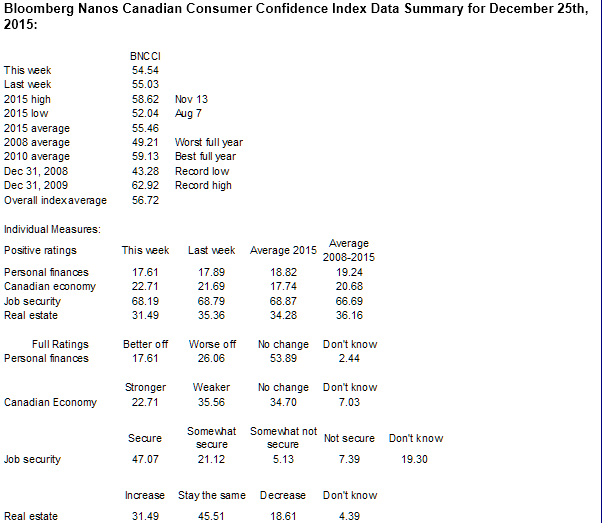
Canadian consumer sentiment in the holiday season continues to show negative pressure according to the Bloomberg Nanos Canadian Confidence Index with declines in main index and the forward looking Expectations Sub-indice.

“Of note, there has been noticeable downward pressure on positive views on the value of real estate over the past week,” said Nanos Research Group Chairman Nik Nanos.

“Consumers have reacted to the extremely low level of interest rates with a worrisome imbalance between housing market speculation and traditional household investment. It seems likely that consumer expectations and spending might suffer until labor-market displacement issues are addressed and households can repair their balance sheets”, said Robert Lawrie of Bloomberg Economics.

The BNCCI, a composite of a weekly measure of financial health and economic expectations, registered at 54.54 compared with last week’s 55.03. The twelve month high stands at 58.62.

The Bloomberg Nanos Pocketbook Index is based on survey responses to questions on personal finances and job security. This sub-indice was at 59.06 this week compared to 59.49 the previous week. The Bloomberg Nanos Expectations Index, based on surveys for the outlook for the economy and real estate prices, was at 50.01 this week (compared to 50.58 last week).

The average for the BNCCI since 2008 has been 56.72 with a low of 43.28 in December 2008 and a high of 62.92 in December 2009. The index has averaged 55.46 this year.

To view the weekly tracking visit our website.

Methodology

The BNCCI is produced by the Nanos Research Corporation, headquartered in Canada,  which operates in Canada and the United States.  The data is based on random telephone interviews with 1,000 Canadian consumers (land- and cell-lines), using a four week rolling average of 250 respondents each week, 18 years of age and over. The random sample of 1,000 respondents may be weighted by age and gender using the latest census information for Canada and the sample is geographically stratified to be representative of Canada. The interviews are compiled into a four week rolling average of 1,000 interviews where each week, the oldest group of 250 interviews is dropped and a new group of 250 interviews is added. The views of 1,000 respondents are compiled into a diffusion index from 0 to 100. A score of 50 on the diffusion index indicates that positive and negative views are a wash while scores above 50 suggest net positive views, while those below 50 suggest net negative views in terms of the economic mood of Canadians.

A random telephone survey of 1,000 consumers in Canada is accurate 3.1 percentage points, plus or minus, 19 times out of 20.

All references or use of this data must cite Bloomberg Nanos as the source.
screenshot-{domain} {date} {time}