Canada flagged for worrying levels of credit and the threat it poses to country’s banks 

By John Shmuel | September 20, 2016

The Bank for International Settlements, a global banking body, is warning that Canada has one of the highest credit-to-GDP ratios in the developed world and that the “unusually” elevated level poses a risk to the country’s banking system.

Canada registered a gap reading of 12.1 in the first quarter of 2016, up from 11.6 during the same period last year. The figure is a comparison of current credit levels to long-run trends. Canada was among the most elevated of developed countries, though it trailed China’s record reading of 30.1.

But the level remains high enough that the BIS singled out Canada as the lone developed country where credit growth remains startlingly high relative to the economy.

“Credit growth continues to be unusually high relative to GDP in several Asian economies as well as in Canada,” the BIS wrote in its quarterly review.

There is some good news in the BIS’ report, however, as Canada’s credit-to-GDP has declined from the highs registered last year, when it reached a gap reading of 15.6 in the fourth quarter. The BIS uses credit-to-GDP as an early warning indicator for financial crises. Its data includes 43 economies, with current credit levels being compared to long-run trends.

Economists in Canada have sounded the alarm on household debt growth for a number of years now. Statistics Canada released data last week that showed the ratio of household credit market debt to disposable income rose from 165.2 per cent in the first quarter to 167.6 per cent in Q2.

Household debt has rapidly risen as housing prices have continually hit new record levels in Canada and homebuyers take out increasingly larger mortgages — as incomes remain stagnant. Toronto and Vancouver have been singled out by the Bank of Canada as two markets where this is a particular concern, as the average single detached home now sells for more than $1 million in both cities.

The BIS said that given low interest rates, countries with high debt loads such as Canada are unlikely to see any stress emerge. And its indicator is not a guarantee that stress will emerge in the future.

But the global banking body again singled out Canada as one country where trouble could emerge if interest rates move higher.

“Estimated debt service ratios, which attempt to capture principal and interest payments relative to income, appear to be at manageable levels at current interest rates for most countries, although they point to potential concerns in Brazil, Canada, China and Turkey,” the BIS wrote in its report.


Source: Canada flagged for worrying levels of credit and the threat it poses to country’s banks | Financial Post

The Housing Bubble Is Over: Trouble Is Brewing

Teacher Suspended Just Because She Told Student: ‘Lick Me Where I Fart’ 

Elizabeth Green-Johnson

By Eric Owens   Sept 20, 2016

A high school English teacher in small-town Ontario has been suspended without pay and is facing an investigation because she allegedly suggested to a student: “Why don’t you lick me where I fart.”

The teacher is Jennifer Elizabeth Green-Johnson, reports the Toronto Sun.

Green-Johnson is listed as a teacher of 10th, 11th and 12th-grade English courses at Dunnville Secondary School in the town of Dunnville — about an hour directly west of Buffalo, New York.

The date of the incident is unclear, but the disciplinary committees of both the local school board and the Ontario College of Teachers have summoned Green-Johnson for a hearing concerning the statement this Friday.

She has landed in hot water for decidedly undiplomatic comments to students in the past.

In 2015, just for example, the English teacher swatted a student on the head, called him an “idiot” and urged him to “grow some balls,” according to the Sun.

Also in 2015, Green-Johnson said “So you like it from behind” as she chided a pair of male students wrestling near her classroom. One of the students had jumped on the other one.

The year 2011 was an especially banner year for Green-Johnson’s antics, according to The Toronto Star.

That year, she “made a comment to the effect that you could not see the actor’s penis without a microscope” in a movie her English class was viewing and — in an effort to stop students from pretending to hit each other in their groins with binders — she “made accidental contact with” a male student’s groin, “causing him to fall to the ground in tears.”

Also in 2011, Green-Johnson told a student to “sit down or I will bop you in the nose.” Around the same time, she told another student to “stop bitching and sit down.”

And she announced to students that ever since she had been “raped” she did not want men to be around her own children.

Green-Johnson further stands accused of describing a student as a “bloody pedophile” and telling another student she looked “like a frumpy old lady today.”

Still more of Green-Johnson’s golden, greatest hits collection — from last academic year — include allegedly saying “I have never said this to a student before, but fuck you” to one student and — to another who made some weird sound with his lips — “It sounds like your ass cheeks are too close together.”

Green-Johnson was previously suspended for her exquisitely colorful and crude language — once for a single day and once for 6 days. Both prior suspensions were without pay.

“It’s pretty unusual for a teacher who has been found guilty of unprofessional conduct to come before us again,” Ontario College of Teachers spokeswoman Gabrielle Barkany told the Star.

Despite the suspensions, Green-Johnson has at least some strong local defenders.

“She is a great teacher who has made, maybe, a couple of bad decisions,” a parent who defends Green-Johnson told a Toronto AM radio host. “Some of the stuff you are mentioning has been blown way out of proportion and I know this because some of the kids involved are friends with my kids.”

“What is being done to this teacher — being put all over social media — is atrocious,” the parent added. “They are bringing up her children on social media.”

Source: Teacher Suspended Just Because She Told Student: ‘Lick Me Where I Fart’ Via @dailycaller

Almost seven in ten Canadians continue to think Trudeau has the qualities of a good political leader in Nanos tracking (ending September 16, 2016)

b5ad68c8-9ced-4798-b6a2-6a4139d994a4

Nanos Weekly Leadership Tracking

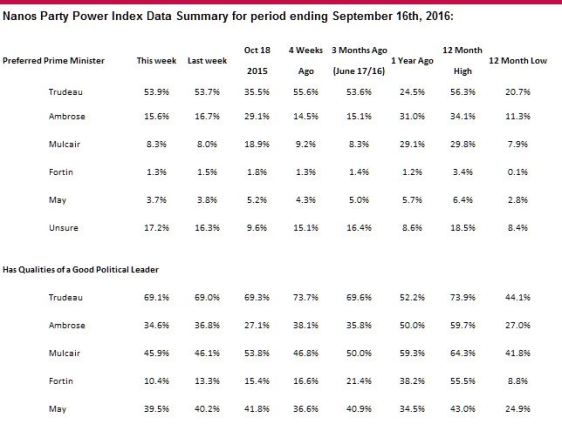
  • Preferred Prime Minister – The latest Nanos tracking as to who Canadians prefer as Prime Minister has Trudeau at 53.9 per cent, Ambrose at 15.6 per cent, Mulcair at 8.3 per cent, May at 3.7 per cent and 17.2 per cent were unsure who they preferred.
  • Qualities of a Good Political Leader – Asked a series of independent questions for each federal political leader, almost seven of ten Canadians (69.1%) think Trudeau has the qualities of a good political leader while 45.9 per cent think Mulcair has the qualities of a good political leader.  Almost four in ten (39.5%) believe May has the qualities of a good political leader and 34.6 per cent believe Ambrose has the qualities of a good political leader.

The team at Nanos in conjunction with Klipfolio have launched our new live political data portal where you run the numbers you want and can explore the trends and data you need.  This is part of our campaign, not only to provide the most reliable data to Canadians but to let them use it as they wish. We were the first to do nightly tracking and now we are the first research organization to post live public opinion data for Canadians.

We were the first to do nightly tracking and now we are the first research organization to post live public opinion data for Canadians. Here’s the link to check it out.

To view the detailed tracking visit our website.

Methodology

The views of 1,000 respondents are compiled into a party power brand index for each party that goes from 0 to 100, where 0 means that the party has no brand power and 100 means it has maximum brand power. A score above 50 is an indication of brand power for the party and its leader at this time.

The important factors in this weekly tracking include the direction of the brand strength or weakness and also the brand power of one federal party relative to another.

The data is based on random telephone interviews with 1,000 Canadians, using a four week rolling average of 250 respondents each week, 18 years of age and over. The random sample of 1,000 respondents may be weighted by age and gender using the latest census information for Canada, and the sample is geographically stratified to be representative of Canada.

The interviews are compiled into a four week rolling average of 1,000 interviews where each week, the oldest group of 250 interviews is dropped and a new group of 250 interviews is added. The current wave of tracking is based on a four-week rolling average of 1,000 Canadians (250 per week) ending September 16th, 2016.

A random telephone survey of 1,000 Canadians is accurate 3.1 percentage points, plus or minus, 19 times out of 20.

All references or use of this data must cite “Nanos Party Power Index” as the source.

nanos

Negative trajectory continues on Canadian consumer confidence (released September 19, 2016)

c7b6bc28-5306-484c-a3d8-9d8998ff23c8

Bloomberg Nanos Weekly Consumer Confidence Tracking

The latest Bloomberg Nanos Canadian Consumer Index showed continued negative pressure on sentiment on all sub measures which comprise the Index.

“Of note, the one week change on the forward views of the strength of the Canadian economy was noticeable and should be monitored ,” said Nanos Research Group Chairman Nik Nanos.

“Households have predictively reacted to the low level of interest rates and limited return on their savings by investing in real estate, an asset with a higher expected return. Their level of investment, however, leaves them more vulnerable to shocks of any nature. So the recent experience of both domestic and global shocks might go a long way in explaining the drop in economic expectations as well as belt-tightening by home owners relative to renters”, said Bloomberg economist Robert Lawrie.

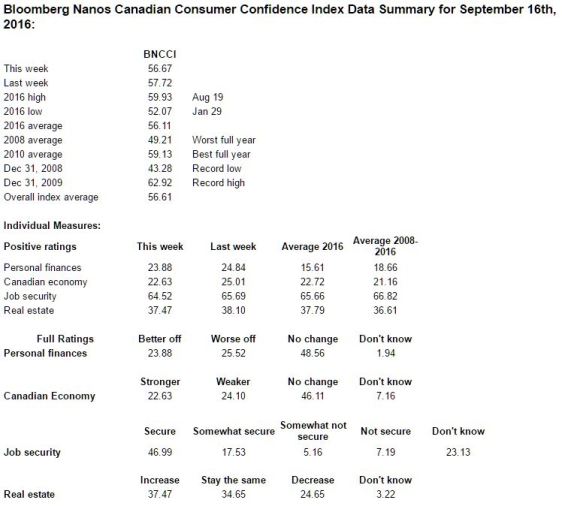
The BNCCI, a composite of a weekly measure of financial health and economic expectations, registered at 56.67 compared with last week’s 57.72. The twelve month high stands at 59.93.

The Bloomberg Nanos Pocketbook Index is based on survey responses to questions on personal finances and job security. This sub-indice was at 60.50 this week compared to 61.49 the previous week. The Bloomberg Nanos Expectations Index, based on surveys for the outlook for the economy and real estate prices, was at 52.84 this week (compared to 53.96 last week).

The average for the BNCCI since 2008 has been 56.61 with a low of 43.28 in December 2008 and a high of 62.92 in December 2009. The index has averaged 56.11 this year.

To view the weekly tracking visit our website.

Methodology

The BNCCI is produced by the Nanos Research Corporation, headquartered in Canada,  which operates in Canada and the United States.  The data is based on random telephone interviews with 1,000 Canadian consumers (land- and cell-lines), using a four week rolling average of 250 respondents each week, 18 years of age and over. The random sample of 1,000 respondents may be weighted by age and gender using the latest census information for Canada and the sample is geographically stratified to be representative of Canada. The interviews are compiled into a four week rolling average of 1,000 interviews where each week, the oldest group of 250 interviews is dropped and a new group of 250 interviews is added. The views of 1,000 respondents are compiled into a diffusion index from 0 to 100. A score of 50 on the diffusion index indicates that positive and negative views are a wash while scores above 50 suggest net positive views, while those below 50 suggest net negative views in terms of the economic mood of Canadians.

A random telephone survey of 1,000 consumers in Canada is accurate 3.1 percentage points, plus or minus, 19 times out of 20.

All references or use of this data must cite Bloomberg Nanos as the source.

capture