
Comprehensive Economic and Trade Agreement (CETA)

From the CUPE National website:

CUPE National President Paul Moist and Council of Canadians National Chairperson Maude Barlow have launched a cross-country tour to oppose the proposed trade deal called the Comprehensive Economic and Trade Agreement (CETA).

This tour will take place prior to the critical eighth round of CETA negotiations between Canada and the European Union in Brussels this July. Prime Minister Stephen Harper said recently he is committed to proceeding ‘full-throttle’ on CETA and on having the deal signed by January 1, 2012, just eight months from now.

Public meetings are scheduled for six cities.

Montreal: May 24, 7 p.m. at the Centre St-Pierre

Toronto: May 26, 7:30 a.m. in the Osgoode Ballroom at the Toronto Sheraton Centre

Saskatoon: May 30, 7:30 p.m. at the Frances Morrison Library

Winnipeg: June 27, 7 p.m. (location to be confirmed)

Halifax: June 28, 7 p.m. at the Italian Canadian Cultural Association Centre

St. John’s:  June 29, 7 p.m. at The Lantern


If CETA is signed it will:

  • threaten our democracy by putting corporate rights first
  • encourage privatization of Canada’s drinking water and wastewater services
  • threaten local job creation and “buy-local” policies
  • cause prescription drug costs to skyrocket by at least $2.8 billion per year
  • allow big corporations to challenge environmental regulations

Together we can stop this trade deal and protect communities, health care and the environment.

Also from the CUPE National website:

Canadian labour united in fight against CETA

May 10, 2011 01:26 PM

The Canadian labour movement is uniting to fight against irresponsible international trade agreements that are threatening our public services and Canadian jobs.

Canada and the European Union are currently negotiating a new Comprehensive Economic Trade Agreement (CETA) which they hope to sign by the end of this year.

Under CETA, large multinational corporations could take over delivery of vital public services – like water and waste disposal – whether communities and local governments like it or not.

On the first day of the Canadian Labour Congress 2011 Convention in Vancouver, BC, over 2,600 delegates passed a resolution calling for the CLC to work towards greater accountability and transparency in CETA negotiations, and to oppose any trade deal which would threaten Canada’s public services.

“CETA poses a threat to every Canadian worker, in every sector of our economy – public and private,” says CUPE National President Paul Moist. “The virtually unrestrained deregulation and privatization possible under CETA not only threatens our valued public services, it puts manufacturing, natural resources, telecommunications, and virtually every other sector of the Canadian economy at great risk.”

There were concurrent resolutions from CUPE, NUPGE, and several regional and provincial labour councils concerning CETA and similar international trade agreements. The CLC Economic and Social Policy Committee, which is co-chaired by Moist, brought forward the following composite resolution.

——————————

The Canadian Labour Congress (CLC) will demand that the negotiations for the Comprehensive Economic and Trade Agreement (CETA) be fully transparent with opportunity for input from the public;

The CLC will support the call for a full evaluation of the social, environmental, and labour aspects of the proposed agreement;

The CLC will ensure that the proposed agreement will not interfere with the right of governments to regulate in the public interest, protect public services, or create new public programs;

The CLC will oppose the inclusion of investor-State provisions and demand that CETA does not force federal, provincial, or municipal governments to open public procurement to foreign companies;

The CLC will make it a high priority to campaign against a flawed CETA, including by providing support to the Trade Justice Network and local coalitions working to oppose CETA;

The CLC will work with allies in Europe to educate and build opposition in Europe;

The CLC will lobby the Federation of Canadian Municipalities to take a strong public position against CETA’s threats to municipal powers;

The CLC will assist Federations of Labour and Labour Councils to persuade provincial governments to exempt municipalities from CETA, working to make CETA a high priority issue in upcoming federal and provincial election campaigns;

Because CETA will reduce the ability of governments, especially local and provincial governments, to act on behalf of citizens, and give new powers to international corporations.
2011 Canadian Labour Congress Convention

I attended the 2011 Canadian Labour Congress Convention in Vancouver from May 9-13, 2011 on behalf of the West Kootenay Labour Council.

I would like to thank the WKLC for giving me the opportunity to attend the conference which was very informative and eye-opening and allowed me join over 2,000 other delegates from coast to coast to coast.

There were a number of themes that captured the 2011 CLC Convention. They included “Good Jobs. Better Lives.”, dealing with labour’s agenda for good jobs in a new economy; “Building On Our Success-Mobilizing for Our Future”; “Recapturing Our Space” which deals with how unions can again establish itself as a positive influence and difference maker in the quality of life for everyone, not just union workers; and, the use of social media to organize, engage, not only union members but society at large.

There were panel discussions on such topics as, “What Derailed the Post-War Social Contract”; “The Silent Majority: Starting the Conversation”; “The Solution is Political: Moving to Political Change”; and finally, “Using new media and social media to organize around ideas, community, and social change”.

The CLC’s four executive officers were re-elected unopposed for a three year term: CLC President Ken Georgetti; Executive Vice-Presidents Barbara Byers and Marie Clark Walker; and, Secretary-Treasurer Hassan Yussuff.

The Convention was dedicated to the memory of Sister Shirley Carr who served as President of the CLC from 1986 to 1992.

CLC President Ken Georgetti opened up the convention by welcoming delegates, and in his opening remarks told attendees “We have to make the winning argument that a strong labour movement whose members have good wages and benefits lifts everyone up, including non-union workers and all businesses. Because without unions, the standard of living will drop for everyone.”

Georgetti continued that there are powerful forces that oppose the union agenda of good jobs for all and more equality in society. “Too often unions are portrayed negatively, inaccurately and unfairly. Put simply, we’ve been framed. Framed by our opponents, by big business, in the media they own; and by right-wing governments.”

“We must examine our public image as unions and be willing to reconsider our strategies to address it….and through an improved public image and the use of accessible social media like Twitter, Facebook, texting and the internet, we are going to step completely our their distorted frame.” Georgetti added.

Jack Layton, leader of the federal NDP and of the Official Opposition, excited everyone with a rousing speech televised throughout Canada on CBC Newsworld, especially when he said that Canada now has the largest united opposition in thirty-one years. Layton pledged that the NDP caucus as the official opposition would fight for improved pensions, improved health care, putting forward practical solutions for working families to make ends meet.

Other speakers during the week included: Adrian Dix, BC Provincial NDP Leader; Jim Sinclair, President of the BC Federation of Labour; Joey Hartman, President of the Vancouver and District Labour Council; Gregor Robertson, Mayor of Vancouver; Sharan Burrow, General Secretary, Internation Trade Union Confederation (ITUC); Richard Trumka, President, AFL-CIO; Academy Award winning director Charles Ferguson whose film ‘Inside Job’ won best documentary Oscar this year in exposing the financial and regulatory negligence that resulted in the biggest economic collapse in 80 years.

Resolutions were debated, with the Chair challenged a few times and there was also passion and conviction with much of the discussion.

Resolutions dealt with included constitution and structure dealing with raids by other unions; a pledge of solidarity to be added to the constitution; an amendment to the council and officers’oath of the constitution which deals with a pledge of solidarity and pledge not to recruit members from other union affiliates; amendment to the terms of reference for ombudsperson of the constitution.

Other resolutions that were approved dealt with: Fair taxes, retirement security for everyone, a child care campaign, public medicare and pharmacare, pay equity, foreign ownership protection for Canadian workers; migrant workers, national energy strategy, CETA,a green jobs strategy, two-tier wages and benefits; organizing and union awareness; ensuring fairness in Federal labour Standards, training for labour representatives on Workers’ Compensation Boards, conventions of the International Labour Organization, free collective bargaining; human rights and civil liberties and living wage campaign.

Also, the time for the CLC and Labour Councils to deal with the question of structure and restructuring was extended with a report to be tabled at the next CLC convention in Montreal, Quebec in 2014. As to how that would be incorporated into the CLC Action Plan was a point of debate among many of the delegates in attendance from Labour Councils, some of who felt like they were being made to do something they were not comfortable doing, for example that Labour Council in Quesnel. This was covered off in a composite resolution that covered CS-11; 13-14; 16 and 23 to 29 of the Resolutions Book and referred back to the Constitution and Structure Committee.

There were plenty of speakers who encouraged members to mobile and become active in the coming months.

Labour councils were encouraged to ensure that those elected in upcoming municipal elections make municipalities matter for working people.

Journalist Harron Siddiqui challenged labour to stand up to the Conservative agenda.

CAW President, Ken Lewenza stated that unions need to build confidence of members, “get jobs back. Private sector and public sector.” And challenged delegates to work together.

Labour needs to be better at telling its story, delegates were told. Pollster Allan Gregg told the convention that the labour movement must first be relevant with its membership and then mobilize beyond the shop floor. He advised delegates to embrace social media as a way to connect.

“Damned if the Harper government is going to balance the budget on patients, medicare and healthcare workers,” the President of the Ontario Nurses Union told the Convention Hall.

As one Sister exhorted “Let’s rise up, Not Shut Up!”

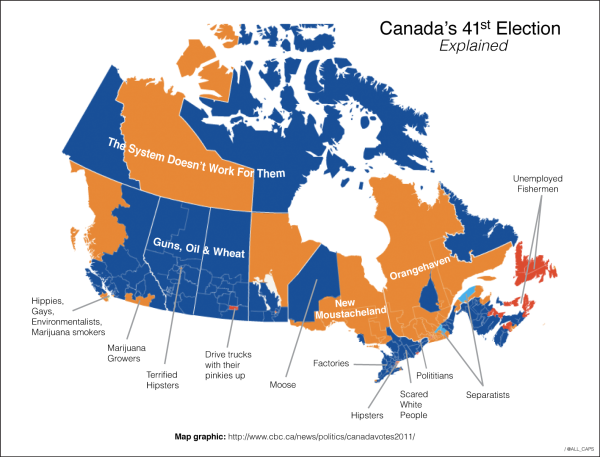
Bitter Sweet: 2011 Canadian Federal Election Result

“Bitter sweet. Won the battle, lost the war”,  Corky Evans, former NDP Kootenay MLA commented to a reporter when asked his opinion on the great showing of the federal NDP party.

My initial observations are as follows:

1)-Conservatives: a strong majority government with no parliamentary impediment to invoking their political will except a strong official opposition and an engaged and vocal Canadian public.

2)-NDP: a strong official opposition. After years of apprenticing, time for the NDP to show what it is made of, keeping in mind that it’s not too late to make a better world….especially a better Canada.

3)-Sixty per cent of popular vote not in favor of Conservatives. Leaves the Conservatives speaking for Canadians but Conservatives don’t represent the majority of Canadian voters of which 61.4 per cent approximately turned out to vote this election.

Conservatives have the majority of the seats but are in minority of the vote.

4)-Demise of the Liberal and Bloc parties. Old guard and leadership in each of those parties had too much of the past; were unable to read the present and had no vision of the future of Canada. Out of touch, period. Did not really seek to understand the concerns and issues of grass root Canadians and make the proper adjustments in their respective ideologies to enable them to engage voters. Big disconnect ended up giving them big loss.

5)-Rebirth of the idea of the Liberals merging with the NDP. More on that another time.

6)-Party controlled democracy was the winner: very unpopular leader becomes Prime Minister because he happens to be the leader of the party in power; a party that led him to the Prime Minister’s chair, and not the other way around.

7)-Failure of a Conservative minority government with a strong opposition controlling the fate of parliament and Harper scare tactics. It left voters wanting a breather from the next federal election and nothing more. Stable government??? Not a chance.

8)-Last but not least: “Have courage my friends”, echoing the words of Tommy Douglas.

Unless Stephan Harper can change his political stripes, leadership style and truly become a Canadian leader for the ages, expect more of the same from him, his party. Undemocratic leadership and policies that demonstrate: no transparency; continuation of being supportive of the privileged and elitist; a Prime Minister and party leader that is arrogant, telling and narrow in his decisions instead of being inclusive, listening and focused on the needs and concerns of grass root, common Canadians, in his decision making.

Stay in touch for more……..until then…..take care.