Shore, Duford Holding Out For As Much As Nighbor
From: The Western Call, Vancouver, B.C., December 3, 1915
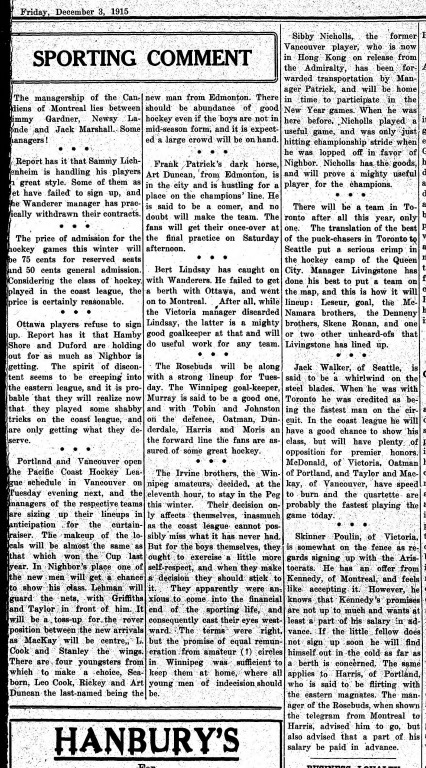

From: The Western Call, Vancouver, B.C., December 3, 1915
by Carla Knipe on 25 Aug 2013 http://thenelsondaily.com

West Kootenay public school students may be gearing up for a new year of classes, but the support staff who work within those schools are bracing themselves for a potential strike, according to Castlegar’s Cherryl MacLeod.
MacLeod works as an education assistant as well as serving as president of CUPE Local 1285, representing both the East and West Kootenays in these negotiations.
She said support staff, which includes custodial and clerical staff, education assistants and bus drivers, have been negotiating with the provincial government for an improved collective agreement ever since it expired 14 months ago. CUPE representatives from across the province have travelled to Vancouver many times since then to negotiate a new contract but those negotiations have been unsuccessful. Support staff in 55 out of 57 CUPE locals voted for strike action in June but have still tried to negotiate collectively.
MacLeod said she is hopeful that the government will summon CUPE representatives back to Vancouver at the beginning of September for another round of talks – but if that does not happen, school support staff will walk off the job by mid-September.
MacLeod says that a strike is a last resort.
“Believe me, we don’t want to have to turn children away from attending school,” she said. “In small towns like Castlegar, we know parents personally. We know that a strike would affect families a great deal. People like to think a strike is just about money, but there are other reasons, such as issues surrounding school calendars and cuts in hours, which we have been facing for a long time.”
She conceded, however, that wages are a large part of contract discussions – and a subject the provincial government is unwilling to address.
“All we are asking is to be treated fairly, like other public sector workers are. Our last wage adjustment was in 2009 and the cost of living has gone up a lot since then, but our wages haven’t,” MacLeod said, adding the average salary of an education assistant is $24,000/year. “That’s not much above the poverty line. We have single parents in support staff positions who are finding it tougher to earn a living wage.”
Because contracts are bargained province-wide, not just locally, a strike would mean support staff across British Columbia would walk off the job. MacLeod also says that Andy Davidoff, president of the Kootenay Columbia Teachers’ Union, has told her that local teachers would respect the picket lines and not cross them, which means schools in the West Kootenay would shut down altogether.
There’s still a possibility strike action will be averted – if not, British Columbia’s students will face a disrupted academic year just as they return to school after summer vacation.


Though many Canadians now see Labour Day as little more than a summer holiday, its origins trace back to a significant time in Canadian history. By the second half of the 19th century, Canadian cities were experiencing an influx of immigrants that caused populations to grow considerably.
This coincided with a changing workplace that was relying more and more on machines, putting workers in an unenviable position. Workers’ once-special skills were now being handled by machines, leaving the working class with little leverage and no recourse to protest low wages, long hours or poor working conditions. Workers who made such protestations were easily replaced, so many simply accepted what their employers had to offer, regardless of how poor that offer was.
Such was the reality in Toronto in 1872, when the Toronto Printers Union began to lobby its employers for a shorter work week. When their demands were ignored, workers went on strike in late March. The strike proved a blow to Toronto’s publishing industry, which had to sit by and watch as a group of 2,000 workers marched through the streets of Toronto in mid-April. As the protesters marched, they garnered more and more support, and eventually the crowd of marchers had expanded to 10,000, or 10 percent of the city’s population.
Though the published industry might have been dealt a significant blow, the response from industry leaders, including Toronto Globe founder George Brown, was less than pleasant. Legal action was taken against the leaders of the strike, and replacement workers from neighbouring towns were brought in. But Prime Minister John A. Macdonald, a political adversary of Brown’s, supported the workers, eventually passing the Trade Union Act that decriminalized unions and led to the strike leaders’ release from jail.
Despite support from the Prime Minister, many workers still lost their jobs, and the goal of a shorter work week was not immediately achieved. But the strike was a significant moment in Canadian history, showing workers they were not powerless. In addition, an annual parade was held in honour of the workers who went on strike, and this celebration soon spread to cities throughout Canada. By 1894, these parades were officially recognized when then-Prime Minister Sir John Thompson declared Labour Day a national holiday.
Metrocreativeconnection.com
NOTE: For more information on the subject in this article, go to:
http://rankandfile.ca/2013/08/14/the-nine-hour-movement-how-civil-disobedience-made-unions-legal/

