From: The Phoenix Pioneer, July 17, 1909
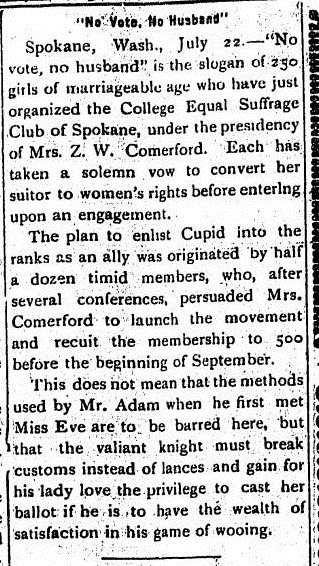

From: The Phoenix Pioneer, July 17, 1909
From: Boundary Creek Times, Greenwood, B.C., August 28, 2013
 Allison Kilkenny on August 28, 2013 http://www.thenation.com

Fast food workers strike in Milwaukee, Wisconsin. (Josh Eidelson)
Fast food workers in cities all across the country are expected to strike Thursday as part of growing protests against the nation’s biggest restaurant and retailer chains. Low-wage workers at businesses like McDonald’s and Macy’s are fighting for a living wage of $15 an hour in pay, which is more than double the current national minimum wage of $7.25.
Organizing against low-paying jobs at fast food restaurants began last November in New York when hundreds of workers went on strike in a one-day protest. By the summer, the movement expanded to include thousands of workers across the country in cities like Detroit, Chicago, and Kansas City.
This time around, workers in places like Los Angeles, Milwaukee, Memphis, and Raleigh, plan on getting involved with backing from the Service Employees International Union (SEIU).
There have already been tangible results from the strikes. Jonathan Westin, who helped organize New York’s first fast food strike as the executive director of New York Communities for Change, says some local workers have seen wage increases of 25 to 50 cents per hour, and Steve Ashby, a professor at the University of Illinois School of Labor and Employment Relations, says some Chicago strikers have also gotten higher wages post-strike.
The achievements, while modest, have also had another effect: lending courage to other workers who want to strike for living wages.
Angela Gholston, 24, has been working at a McDonald’s in Detroit for two years, and says she’s participating in the strike to help form a union, and make better wages so she can support her family and pay her bills.
“I receive Medicaid because I can’t even afford to pay for my employer’s health care plan,” she says.
Gholston has participated in past strikes at work, and says she feels emboldened by the organizing she’s seen in other states.
“They’re trying to help us and we’re trying to help them, and that’s good. We have to stand together in order to keep this movement going. We need [$15-per-hour minimum wage], not $7.40. What can we do with $7.40?”
Gholston says she wasn’t hesitant to participate in the strike even though she lacks the protection of a union.
“We need to make a union. That’s the whole point of going on strike. If you don’t take action and stand up for what’s right, who is going to do it for you? I wasn’t scared at all.”
Mike Wilder, co-founder of the African American Roundtable in Milwaukee and Community Coalition Coordinator with Wisconsin Jobs Now, and campaign leader of Raise Up MKE—a group focused on fighting for living wages—says the strike is about holding profitable companies accountable for not paying workers enough to afford basic amenities like food and rent.
In Milwaukee, Wilder says organizers and workers have planned a day full of actions at specific stores throughout the city.
“Here in Milwaukee, the day will end with a march and a rally in support of low wage workers in one of the city’s poorest neighborhoods,” says Wilder.
Wilder says Thursday is one step in a much larger movement.
“All across the country, workers are standing up and demanding higher wages so they can support themselves and their families without having to seek government assistance,” he says. “In Milwaukee, we started with a few dozen workers on strike in May, and now we have hundreds striking. Workers are planning future escalating actions until their demands are met.”
Wilder adds the goal of these types of actions is to send a message to “these billion dollar corporations that workers are no longer going to struggle to survive on minimum wage, while record-breaking profits are generated by the companies that employ them. Workers are demanding [$15-per-hour minimum wage] and the right to form a union without retaliation.”
Dwight Murray, 27, has been working at a McDonald’s in Indianapolis since March, and says he’s participating in the strike because he gives a lot to McDonald’s.
“I work hard and I deserve to make enough to meet my family’s basic needs,” says Murray. “I struggle to get my 3-year-old daughter what she needs, and we have to make sacrifices on a regular basis. I’m going on strike because I deserve to make a liveable wage and to be able to take care of my daughter and even have money saved up for emergencies.”
Murray says fast food workers aren’t treated with the respect they deserve on the job.
“We’re working hard to live up to the ‘hot, fresh, and ready in a minute-and-a-half’ standard, but sometimes there’s not enough staff, so we work eight hours without a break.”
Murray claims he’s been told that no overtime is allowed, but then if his replacement doesn’t show up, he can’t leave, and then his superiors “gripe” about paying for a single hour at the overtime rate. He adds that none of the employees can count on raises, and the people who work hard and have been there the longest in crucial roles sometimes don’t get raises at all.
This is the first time Murray has ever gone on strike, but he says he feels bolstered by actions in other states.
It gave me even more incentive to join and put a fire in my belly to stand up for this. Before, I didn’t feel that there was a proper avenue for me to be heard. Now, I see that there is, and that I’m not alone. I’m standing up for myself and my coworkers, but also the millions of other workers across the country that also deserve a liveable wage.
Proving that indeed courage is contagious, Murray says he feels safe striking because he knows other workers have his back, and there are workers across the country standing up together.
I know my rights and I’m talking to other workers about their rights. There are workers in cities across the country going on strike together. We’re standing together in order for us to obtain a liveable wage.
Parts of these interviews were edited for clarity.

Fast food workers strike in Milwaukee, Wisconsin. (Josh Eidelson)
Fast food workers in cities all across the country are expected to strike Thursday as part of growing protests against the nation’s biggest restaurant and retailer chains. Low-wage workers at businesses like McDonald’s and Macy’s are fighting for a living wage of $15 an hour in pay, which is more than double the current national minimum wage of $7.25.
Organizing against low-paying jobs at fast food restaurants began last November in New York when hundreds of workers went on strike in a one-day protest. By the summer, the movement expanded to include thousands of workers across the country in cities like Detroit, Chicago, and Kansas City.
This time around, workers in places like Los Angeles, Milwaukee, Memphis, and Raleigh, plan on getting involved with backing from the Service Employees International Union (SEIU).
August 27, 2013 by Joshua Holland http://billmoyers.com
Two studies released last week confirmed what most of us already knew: the ultra-wealthy tend to be narcissistic and have a greater sense of entitlement than the rest of us, and Congress only pays attention to their interests. Both studies are consistent with earlier research.
In the first study, published in the current Personality and Social Psychology Bulletin, Paul Piff of UC Berkeley conducted five experiments which demonstrated that “higher social class is associated with increased entitlement and narcissism.” Given the opportunity, Piff also found that they were more likely to check themselves out in a mirror than were those of lesser means.
Piff looked at how participants scored on a standard scale of “psychological entitlement,” and found that those of a high social class — based on income levels, education and occupational prestige — were more likely to say “I honestly feel I’m just more deserving than others,” while people further down the social ladder were likelier to respond, “I do not necessarily deserve special treatment.”
In an earlier study, published last year in the Proceedings of the National Academy of Sciences, Piff and four researchers from the University of Toronto conducted a series of experiments which found that “upper-class individuals behave more unethically than lower-class individuals.” This included being more likely to “display unethical decision-making,” steal, lie during a negotiation and cheat in order to win a contest.
In one telling experiment, the researchers observed a busy intersection, and found that drivers of luxury cars were more likely to cut off other drivers and less likely to stop for pedestrians crossing the street than those behind the wheels of more modest vehicles. “In our crosswalk study, none of the cars in the beater-car category drove through the crosswalk,” Piff told The New York Times. “But you see this huge boost in a driver’s likelihood to commit infractions in more expensive cars.” He added: “BMW drivers are the worst.”
Summing up previous research on the topic, Piff notes that upper-class individuals also “showed reduced sensitivity to others’ suffering” as compared with working- and middle-class people.
Lower-class individuals are more likely to spend time taking care of others, and they are more embedded in social networks that depend on mutual aid. By contrast, upper-class individuals prioritize independence from others: They are less motivated than lower-class individuals to build social relationships and instead seek to differentiate themselves from others.
These findings may appear to represent a bit of psychological trivia, but a study to be published in Political Science Quarterly by Thomas Hayes, a scholar at Trinity University, finds that U.S. senators respond almost exclusively to the interests of their wealthiest constituents – those more likely to be unethical and less sensitive to the suffering of others, according to Piff.
Hayes took data from the Annenberg Election Survey — a massive database of public opinion representing the views of 90,000 voters — and compared them with their senators’ voting records from 2001 through 2010. From 2007 through 2010, U.S. senators were somewhat responsive to the interests of the middle class, but hadn’t been for the first 6 years Hayes studied. The views of the poor didn’t factor into legislators’ voting tendencies at all.
As Eric Dolan noted for The Raw Story, “The neglect of lower income groups was a bipartisan affair. Democrats were not any more responsive to the poor than Republicans.” Hayes wrote that his analysis “suggests oligarchic tendencies in the American system, a finding echoed in other research.”
Hayes’ study is consistent with earlier research, including Princeton University scholar Larry Bartels’ 2005 study of “Economic Inequality and Political Representation.”
There are a few of ways of looking at these findings. They could be the result of genuinely held ideological beliefs which happen to justify inequality and privilege.
According to OpenSecrets, the average net worth of senators in 2011 was $11.9 million, so it could be a matter of legislators advancing their own interests and those of the people with whom they socialize and associate.
But MIT economist Daron Acemoglu, who co-authored Why Nations Fail with Harvard’s James Robinson, says that this kind of political inequality is a product of widening economic disparities. “It’s a general pattern throughout history,” he told Think Progress. “When economic inequality increases, the people who have become economically more powerful will often attempt to use that power in order to gain even more political power. And once they are able to monopolize political power, they will start using that for changing the rules in their favor. And that sort of political inequality is the real danger that’s facing the United States.”


