Union women work to shatter labour’s glass ceiling

By H.G. Watson     December 4, 2013   http://rabble.ca

Photo: flickr/Ian Sane

The labour movement’s female ranks are growing, but women are still struggling to have their voices heard and to fill executive positions.

“Sadly, I still find myself in the trenches,” said Yolanda McClean, the Diversity Vice-President of CUPE, speaking at the microphones during the women’s forum at the Ontario Federation of Labour (OFL) convention.

Women, even in unionized workplaces, face workplace harassment and income inequality.

For those that might consider leadership positions, there are still barriers in the way of taking executive roles at the local or national levels — including a lack of available childcare and mentoring — despite the fact that there are more women unionized than ever before.

A recent Globe and Mail article found that the rate of men who are unionized is dropping while rates for women have held steady. The losses for men is found in the declining manufacturing sector while unionization rates in health care, education and public administration — industries largely dominated by women — have grown.

Men still take up many of the top positions in labour unions and councils, a situation that has certainly not gone unnoticed by union sisters. At the Unifor founding convention in August, Lindsay Hinshelwood, a member of the former CAW local 707 in Oakville, Ontario, ran against Jerry Dias to challenge what she called the “old boys club” of leadership.

“Traditional power structures still exist within the labour movement which is really unfortunate,” said Nicole Wall, a Toronto based regional representative of the Public Service Alliance of Canada.

She, along with her mother, labour activist Carol Wall, sat on a panel about the challenges women face in the labour movement last Tuesday at the OFL convention.

They were joined by Katie Arnup, a national representative for communications at Unifor, Sue Genge, who was formerly with the Canadian Labour Congress (CLC) and the Canadian Union of Public Employees (CUPE) and Michele Landsberg, a journalist who has written extensively on labour issues.

Landsberg recounted that when she attempted to write a story about maternity leaves many years ago, she was laughed off the phone by many of the union leaders when she asked if they would include leave provisions in collective agreements.

“I’ve heard a woman say that she ran for an elected position and she was told she’d get in trouble with her union supervisor because they didn’t want a woman running,” she said.

If there is anyone who knows the challenges of becoming not only active in labour, but a leader, it would be Nancy Hutchison. The secretary-treasurer of the OFL was the first woman to work in the gold mine in the Campbell Red Lake Mine in 1977. Hutchison became the president of her union local, and eventually rose through the ranks of the United Steelworkers to take a place on their national executive as the Canadian National Health, Safety and Environment Department Leader.

“Very rarely will a sister come up and say, ‘it’s my first year working here and I want to be involved in the union,'” she said. “It’s up to us to look for [leadership] qualities.”

Mentorship opportunities and access to childcare were two of the key barriers she identified for women who may consider running for leadership positions.

At the OFL convention, there were several impassioned speeches in support of a universal childcare system. Others also advocated for maternity leaves to be included in collective agreements — a situation that they argue benefits families overall, not just women.

But according to Landsberg, union culture has to become more inclusive — or risk disappearing altogether.

“The union movement has done amazing things for changing the scene for women externally,” she said, noting that unions supported Charter challenges that helped secure the right to choice.

“But internally, they haven’t done as much and they have to because that is the future of unionizing –they need the women or they are gone.”

Where Did Our Rights Come From? The Rand Formula and the Struggle for Union Security

http://www.unifor.org

Nov 20, 2013

Today our basic rights to freedom of association, democratic representation in the workplace, and free collective bargaining may be easy to take for granted as having always been with us. But these rights didn’t just happen. They weren’t gifts from enlightened employers or kindly governments!

At a time when powerful corporations and their friends in government are trying to roll back the clock on workers’ rights, we have much to learn from the inspiring, and often untold, stories of the workers and activists who fought for the rights we enjoy today, and won.

You can also download the various components of the book as individual files:

Document

Where Did Our Rights Come From? The Rand Formula and the Struggle for Union Security

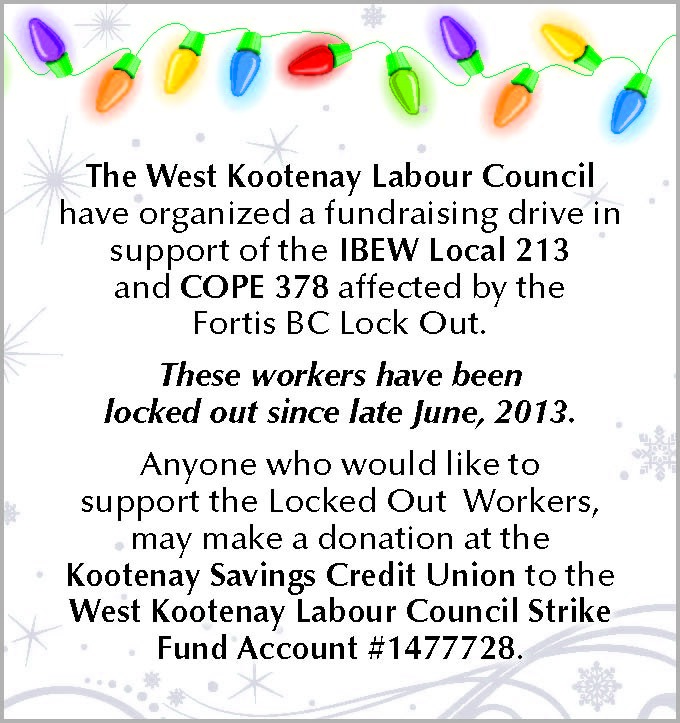
FortisBC and Kensington, PEI: Grinch’s This Christmas With Their Employees

By Andrew Chernoff    https://andrewchernoff.wordpress.com/

On different sides of the country, two groups of union members with differences but with two unfortunate things in common: different unions, in different sectors, one union in the private sector, one in the public sector, the two groups of union members are locked out with employers acting like Grinch’s this Christmas.

Unless a Grinch’s Heart Grows, Locked Out FortisBC Workers Won’t Have A Merry Christmas.

Unless a Grinch’s heart grows, this story of 225 locked out electrical workers won’t have a very merry ending. The latest round of negotiations between FortisBC and its electrical workers have failed; all but ensuring the workers will be locked out for the holiday season.

Two days of talks broke off on December 5, 2013 with no end in sight for the nearly six month lockout that began on June 26.

For 225 workers across the southern interior who haven’t seen a paycheque in six months, Christmas is going to be really tough. For FortisBC which has saved over $7 million dollars and is only raising rates another 19% by 2018, obviously Christmas doesn’t matter much. Except of course for its CEO, who will take in another $1.4 million this year. He’ll certainly be jolly, while his workers are freezing and his customers are paying more.

Since locking out its electrical employees FortisBC has continued to only add requirements for a deal to be done. Negotiations collapsed today because the company will not budge from two significant demands: a mandatory compressed work week which entails longer working days for less money, and the Union’s surrender of its legal right to labour action in the System Control Centre.

After suffering six months without pay, the Union wanted its members back to work so at least Christmas could be a happy time spent with their family. Seeking to be flexible, three proposals were brought to the table. One was the same, identical deal FortisBC signed yesterday with COPE 378, its office workers, and the company said no. The second proposal was a basic, plain back-to-work agreement, that included only minimal wage increases of 2.5%-2%-2%-2.5%-2.5%, no other changes, and the company said no.

Though it would be hard for workers with young families, the third proposal included a compromise on the mandatory compressed work week. All workers would be forced to be on the compressed work week if 50%+1 of the crew voted for it or if 75% of the workers’ headquarters voted for it. The company had already agreed to a 5% premium as compensation for working the longer 10 hour day which would significantly encourage workers to vote for it. However FortisBC rejected this compromise.

If these demands of a compressed work week and giving up right to strike were so important for FortisBC, why didn’t the company bring them up earlier? Why did FortisBC only make these demands months after its workers were locked out? It would appear FortisBC isn’t interested in a deal or compromise; it just wants its workers locked out until FortisBC can get whatever it wants.”

Town of Kensington, PEI Locks Out Its Employees

With less than three weeks until Christmas, the Town of Kensington, PEI has locked out a half dozen of its CUPE Local 4893 unionized employees.

The move, said CUPE national representative Stacy Delaney, blindsided the employees who were in the midst of contract negotiations with the town.

“The part we find most disturbing,” she says, “is that although there is no good time for workers to be locked out by an employer, it is less than three weeks before Christmas and this employer is choosing to lock its employees out of work. This is cold-hearted, to be sure.”

“This came right out of left field for us. We never imagined that the employer would take the stance to lock out members tomorrow morning,” Delaney said late Tuesday. “We were in talks. We put a final offer in. We counter-offered and then we basically rejected their counter-offer to us. We felt we would just wait and go to arbitration and proceed.”

Delaney said CUPE national and the local will provide some financial support to the employees and the union will send out an appeal for the support of other unions and CUPE locals on the Island and in the region “to make this as painless as possible.” 

“It is really hard to know how long it will play out. A lot of people are in shock. We have to have those conversations,” she added. “The goal is to support everyone and get them through. It is a rough time of year, Christmas time.”

CUPE National Representative Stacy Delaney says, “CUPE Local 4893 members, consisting of Police Officers, Communication Technicians, Public Works and Janitors, were told that as of tomorrow morning (December 4, 2013), all employees excluding Police Officers will be locked out.”

Delaney says Local 4893’s contract expired in April 2013. After five days of bargaining with the Town of Kensington in May, the parties were unable to reach an agreement. That’s when the union filed for conciliation.

Three more days of conciliation took place in September and October. The matter was referred to a Board of Arbitration on October 8th, 2013 by the Minister of Environment, Labour and Justice, Janice Sherry.

Delaney says, “The outstanding issues all relate to equality and fairness for this group of employees, things like on-call pay for part-time police officers, wages and the duration of the contract. We are not asking for anything more than what other Town of Kensington employees have received.

Canada Shows the Power of Unions


Jim Stanford  Jim Stanford is an economist with Unifor.

December 4, 2013    http://www.nytimes.com

The dream of a decent, “middle class” life still exerts a powerful influence in North American culture. But we often forget that the middle class is actually a relatively recent creation. It was largely a result of working people organizing to win a decent share of prosperity, especially through unionization and collective bargaining.

A major reason for Canada’s greater income equality is that unions represent 31 percent of its workers, compared to 12 percent in the U.S.

There is an inherent asymmetry between employers and workers. Without institutional structures to strengthen workers’ position, workers get enough to survive, while owners, investors and a few professionals pocket the lion’s share of economic growth.

Auto factory wages and working conditions were traditionally poor. Unionization and collective bargaining improved incomes and security, so workers could afford home ownership, a comfortable retirement and college tuition for their kids. In other industries, too, lousy jobs became middle-class jobs, thanks largely to unions.

Many assume that a restaurant job is inherently a poverty-level job. But collective bargaining could help restaurant workers improve wages and working conditions and attain a better life.

Income distribution is far more equal in Canada than in the United States, despite the similarity of their economies. That’s largely because unions represent 31 percent of workers in Canada, compared to 12 percent in the United States. (The minimum wage is Canada is generally around $10 an hour.) Prosperity is shared more broadly.

Higher unionization in Canada is the culmination of many small differences in labor law. In most jurisdictions, unions can be certified when a clear majority of workers sign union cards. There are stronger protections against being fired for union activity (including organizing drives and strikes). Union dues are usually deducted at source by the employer and forwarded to the union. Contracts can be settled by arbitration for new bargaining units or in the event of long work stoppages. In some provinces, employers are not permitted to hire replacement workers during strikes. All of this means that Canadian workers have a better chance to form a union and negotiate a fair deal with their employers.

To be sure, unions are under pressure in Canada (as in the United States) from globalization and hostile employers, and the erosion of unionization would undermine Canada’s social equality. But the positive impact of collective bargaining on equality and social inclusion is still evident.

The collective action of restaurant workers brought public attention to their low pay and insecurity. By formalizing that collective power they could turn their lousy jobs into decent ones.