More young adults are failing to launch or ‘boomerang’ home: study

The study, conducted by researchers at the University of Melbourne, concluded that the changing nature of family living situations often led to avoidable conflict.

Associate Professor Cassandra Szoeke and Katherine Burn, from the University’s Faculty of Medicine, Health and Dentistry Sciences, examined both ‘boomerang kids’ (those who return home) and ‘failure to launch’ kids (those who never left).

The project reviewed 20 studies involving 20 million people worldwide was published in Maturitas.

“A lot of the conflict that arises in these situations is avoidable if the roles and expectations of both parties are redefined from the outset,” Assoc Prof Szoeke said.

The research shows:

  • The shifting economic climate and changes in social norms were driving the phenomenon of kids staying at home for longer.
  • The main reasons for young adults choosing to remain at home were for stability and additional support while they transition to university or employment.
  • Divorce, unemployment and health problems often led to children returning. This return under negative circumstances can heavily impact on the wellbeing of everyone in the household.
  • Parents who are well-educated, married and well-off tend to have children who stay home longer, whereas children who grow up in households with a single parent, or step-parent, or didn’t finish high school, tend to leave early.

“For young adults grappling with financial and domestic independence, the family home represents a safe haven,” co-investigator Katherine Burn said.

“But parents can become beleaguered by the financial and emotional demands of their dependent adult children and struggle to maintain their own independence.”

Associate Professor Cassandra Szoeke added that adult children living at home often didn’t contribute to housework and were a financial drain on the parents, disrupting plans for retirement.

“Delayed independence and multigenerational households result in changes in family structure and relationships and has a strong impact on the lives of both the parents and adult children,” Associate Professor Szoeke said.

The investigators concluded more research is needed to examine this growing social phenomenon.

Source: University of Melbourne

Source: More young adults are failing to launch or ‘boomerang’ home: Study | Science Codex

Liberals hit record high in Nanos Party Power Index – Nanos Weekly Tracking (ending November 6, 2015)

The Nanos Party Power Index

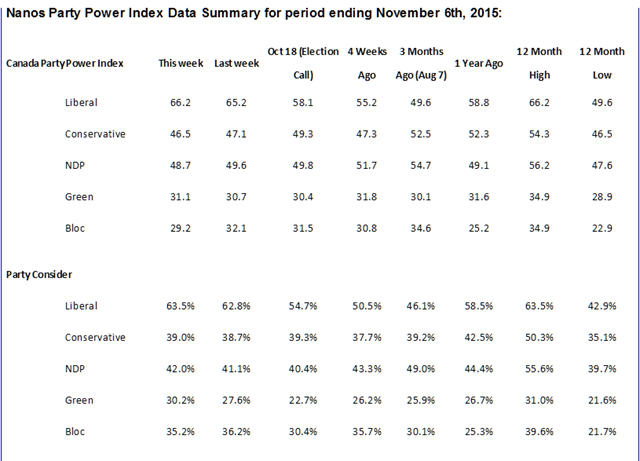
  • Nanos Party Power Index –  The Liberals have hit a new high in the Nanos Party Power Index and have registered the highest single score since the index began in 2013.  The Index which is a composite of a series of questions including ballot preferences and impressions of the leaders, had the Liberals with 66.2 out of a possible 100 points followed by the NDP with 48.7 points, the Conservatives with 46.5 points, the Greens with 31.1 points and the BQ with 29.2 points (QC only).
  • Accessible Voters – Liberal accessible voters hit a new high for any party.  More than six of ten (63.5%) of Canadians would consider voting Liberal compared to 42.0% who would consider voting NDP, 39.0% who would consider voting Conservative, 30.2% who would consider voting Green and 35.2% of Quebecers who would consider voting for the BQ.

The team at Nanos in conjunction with Klipfolio have launched our new live political data portal where you run the numbers you want and can explore the trends and data you need.  This is part of our campaign, not only to provide the most reliable data to Canadians but to let them use it as they wish. We were the first to do nightly tracking and now we are the first research organization to post live public opinion data for Canadians. Here’s the link to check it out

To view the detailed tracking visit our website.

Methodology

The views of 1,000 respondents are compiled into a party power brand index for each party that goes from 0 to 100, where 0 means that the party has no brand power and 100 means it has maximum brand power. A score above 50 is an indication of brand power for the party and its leader at this time.

The important factors in this weekly tracking include the direction of the brand strength or weakness and also the brand power of one federal party relative to another.

The data is based on random telephone interviews with 1,000 Canadians, using a four week rolling average of 250 respondents each week, 18 years of age and over. The random sample of 1,000 respondents may be weighted by age and gender using the latest census information for Canada, and the sample is geographically stratified to be representative of Canada.

The interviews are compiled into a four week rolling average of 1,000 interviews where each week, the oldest group of 250 interviews is dropped and a new group of 250 interviews is added. Note: the current wave of tracking is based on the final weekend of the election writ period ending October 18th as well as the three weeks ending November 6th. As we move forward the tracking will revert to a four-week rolling average of 1,000 Canadians (250 per week).

A random telephone survey of 1,000 Canadians is accurate 3.1 percentage points, plus or minus, 19 times out of 20.

All references or use of this data must cite “Nanos Party Power Index” as the source.

image

Vancouver Ends 3-Game Losing Streak With First Road Trip Win

CANUCKS BANTER     By Andrew Chernoff    November 10, 2015
Henrik Sedin Scores Twice In 3rd-Period,

Daniel Sedin, Jannik Hansen Get 4-Points Each,

Jacob Markstrom Stops 42-Shots

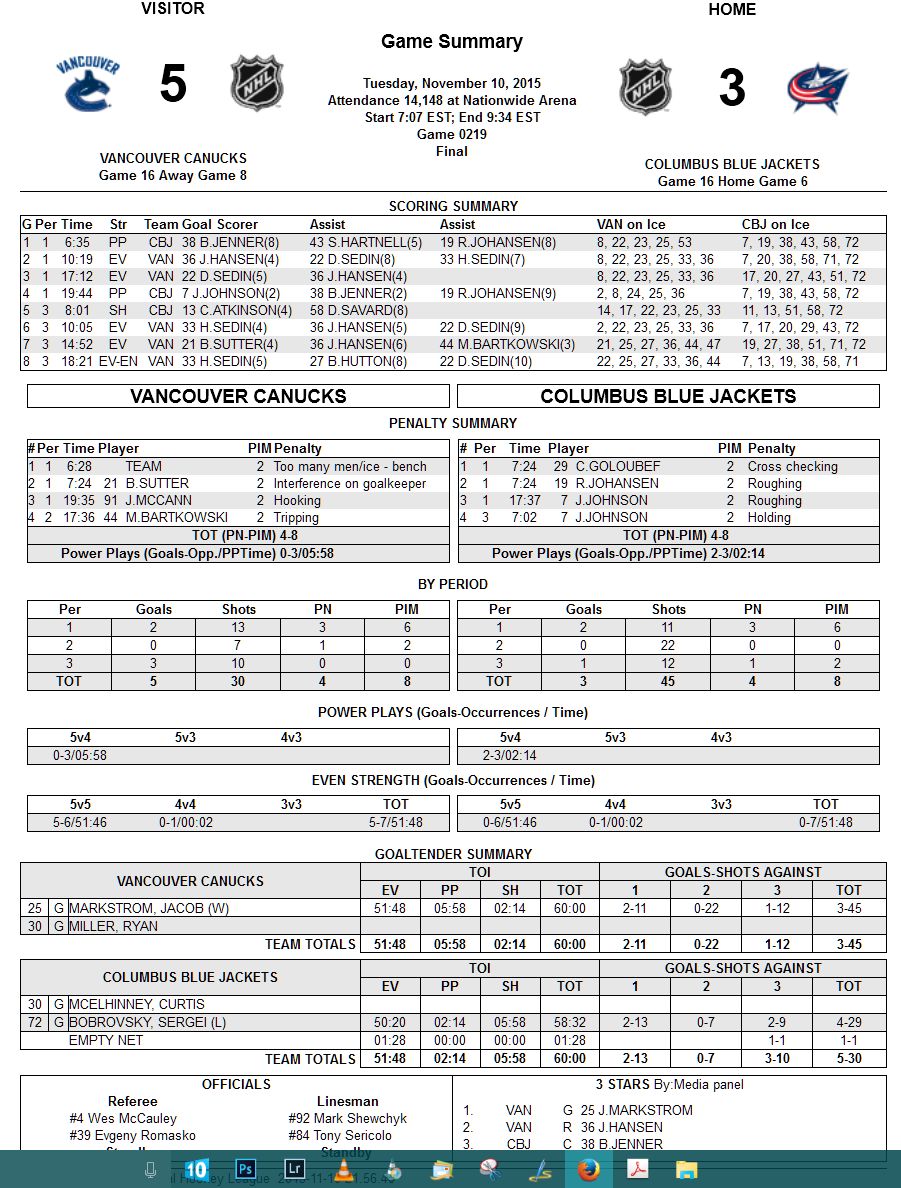
The Columbus Blue Jackets gave it all they had, and Jacob Markstrom played an outstanding game in his season debut for the Canucks, stopping 42 of 45 shots, defeating Columbus 5-3 for his first win.

Vancouver ended their three consecutive game losing streak, in winning their first game of their current 7-game road trip after consecutive losses to the Buffalo Sabres and New Jersey Devils.

Vancouver’s special teams were not so special as they gave up two power play goals, one short-handed goal; and failed to score on three power play opportunities.

The Canucks power play is now 0-16 in their last 5-games, and they have allowed shorthanded goals in two consecutive games.

The Canucks are now 1-1-1 on their road trip, as they hand Columbus their 6th-loss at home without a win, this season.

A line composed of the Sedin brothers and Jannick Hansen put the Canucks on the scoreboard in the first period after the Blue Jackets took a 1-0 lead with a power play goal, with goals from Hansen and Daniel Sedin. 

But before you could turn to get out of your seat and grab a beer at the period break, the Canucks allowed a power play goal to Columbus with 16-seconds left in the opening period, for a 2-2 tie at the intermission.

The score stayed at 2-2 until late in the first half of the 3rd period when the Blue Jackets scored a shorthanded goal, to go up 3-2. That is when Henrik Sedin went to work with Jannik Hansen and Brandon Sutter, taking over the game as Henrik Sedin and Sutter scored to pull a head of Columbus 4-3. Henrik added an empty net goal for his second goal of the 3rd-period to put the game away.

CANUCK JOTTINGS

  • Jannik Hansen and Daniel Sedin fished the game with 4-points each (1-3-4 each); Henrik Sedin had 3-points (2-1-3). Hansen was a +5, with the Sedin’s each a +3 in the game.
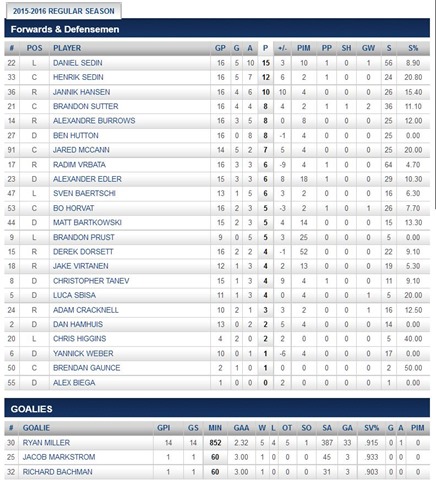
  • Daniel Sedin has 12-points (4-8-12) in his last 11 games and currently leads the team in scoring with 15-points (5-10-15).
  • The game was the first of two meetings this season between the Canucks and Blue Jackets. Columbus will visit Vancouver on Feb. 4th. Vancouver split the season series versus the Blue Jackets last season.
  • Overall the Canucks are 7-2-2 in their last 11-meetings versus Columbus, including tonight’s game.
  • Daniel Sedin, and Henrik Sedin tied rookie Jared McCann for the team lead in goals with their 5th goals of the season tonight.

GAME SUMMARY

can33

image

2015-2016 CANUCK STATS

can30