Canada July manufacturing sales climb 0.1 pct, less than expected 

http://www.reuters.com   Sept 16, 2016

Canadian manufacturing sales in July edged up by 0.1 percent as strength in the food, energy and metals industries was offset by weakness in the machinery and aerospace sectors, Statistics Canada data indicated on Friday.

Analysts in a Reuters poll had forecast a 1.0 percent increase from June. Sales advanced in nine of 21 industries, representing around 54 percent of the manufacturing sector while in volume terms, sales climbed by 0.6 percent.

Food industry sales rose by 1.9 percent, in part because manufacturers were able to overcome supply difficulties that had caused shortages of canola in May and June.

Sales in the primary metals industry rose by 2.9 percent while petroleum and coal products posted a 2.5 percent gain on higher volumes at several oil refineries.

Production in the aerospace and products parts industry – known for its volatility – sank by 9.0 percent while machinery sales fell by 3.3 percent.

(Reporting by David Ljunggren; Editing by Bernadette Baum)

Source: UPDATE 1-Canada July manufacturing sales climb 0.1 pct, less than expected | Reuters

Food waste could store solar, wind energy

Date: September 15, 2016

Source: American Chemical Society (ACS)

Saving up excess solar and wind energy for times when the sun is down or the air is still requires a storage device. Batteries get the most attention as a promising solution although pumped hydroelectric storage is currently used most often.

Now researchers reporting in ACS’ Journal of Physical Chemistry C are advancing another potential approach using sugar alcohols — an abundant waste product of the food industry — mixed with carbon nanotubes.

Electricity generation from renewables has grown steadily over recent years, and the U.S. Energy Information Administration (EIA) expects this rise to continue. To keep up with this expansion, use of battery and flywheel energy storage has increased in the past five years, according to the EIA. These technologies take advantage of chemical and mechanical energy.

But storing energy as heat is another feasible option.

Some scientists have been exploring sugar alcohols as a possible material for making thermal storage work, but this direction has some limitations. Huaichen Zhang, Silvia V. Nedea and colleagues wanted to investigate how mixing carbon nanotubes with sugar alcohols might affect their energy storage properties.

The researchers analyzed what happened when carbon nanotubes of varying sizes were mixed with two types of sugar alcohols — erythritol and xylitol, both naturally occurring compounds in foods.

Their findings showed that with one exception, heat transfer within a mixture decreased as the nanotube diameter decreased. They also found that in general, higher density combinations led to better heat transfer.

The researchers say these new insights could assist in the future design of sugar alcohol-based energy storage systems.

Story Source:

The above post is reprinted from materials provided byAmerican Chemical Society (ACS). Note: Content may be edited for style and length.


Journal Reference:

  1. Huaichen Zhang, Camilo C. M. Rindt, David M. J. Smeulders, Silvia V. Nedea. Nanoscale Heat Transfer in Carbon Nanotubes – Sugar Alcohol Composite as Heat Storage Materials. The Journal of Physical Chemistry C, 2016; DOI:10.1021/acs.jpcc.6b05466

Source: Food waste could store solar, wind energy

There’s an open sea at the North Pole, and it’s got experts very worried 

RAFI LETZTER, BUSINESS INSIDER

Sept 15, 2016

Writing about climate change presents an interesting challenge. It’s a slow, constant process. Global temperatures rise a little every year, bit by bit accruing disastrous consequences.

We get used to hearing that this year, like many years in recent memory, will be the hottest on record. That glaciers are melting. That food insecurity is increasing. That more and more people face climate-induced natural disasters.

As with any slow-moving (on human timescales) tragedy, it’s difficult to sustain the degree of attention and horror that each new development deserves.

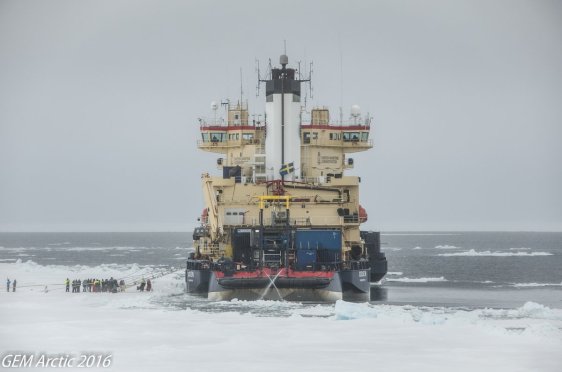
But then you see something like this:

cq8eyckwgaag2ri

That’s a photo of a Swedish icebreaker sitting in open water at the North Pole, published about two weeks ago. (I first saw it retweeted on weather writer Eric Holthaus’s Twitter account.)

Let’s put that in context. The North Pole has been entirely covered in ice, including during the summer, for thousands of years. That was still the case when I graduated from high school, and I’m 24.

But a few years ago, predictions that our warming climate would cook the Arctic ice cap until it melted came true.

Photos of a lake near the North Pole went briefly viral, then quickly faded from view. Now, the Canadian Coast Guard can publish images of open sea at the North Pole and it can pass largely unnoticed.

(One caveat: Though the CCG describes this image as from the North Pole, we don’t know exactly where in the Arctic sea it was shot. I’ve reached out to them for comment and will update if I hear back.)

The thing is, people know that climate change is a problem. Gallup reports that 64 percent of US adults are worried “a great deal” or “a fair amount” about climate change.

It’s hard to stay energised when there’s so much else happening to worry about, though, and that often means that the conspiracists and truthers are the loudest voices.

But in a world where a major presidential candidate can offer no policy proposal at all to address climate change, without any apparent political repercussions, I still think a picture of open ocean at the North Pole is worth paying attention to.

Source: There’s an open sea at the North Pole, and it’s got experts very worried – ScienceAlert

Canada’s Wage Gap Is Worse Than The OECD Average

Sept 15, 2016

TORONTO — A global education study reveals larger-than-average earning gaps between Canadian men and women, but that narrows as women pursue higher levels of study.

The report from the Organization for Economic Co-operation and Development analysed data from 35 member countries and 11 partner countries.

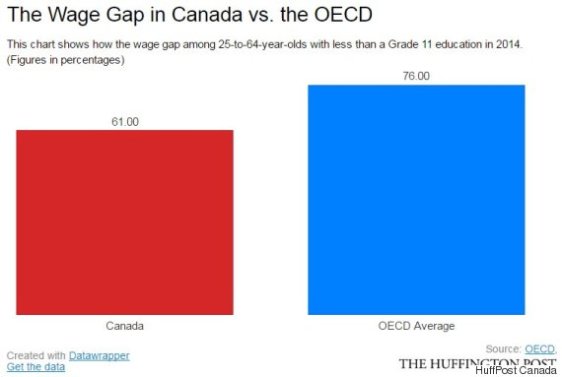
Among 25- to 64-year-olds with less than a Grade 11 education, Canadian women earned 61 per cent of what men earned in 2014, compared with the 76 per cent average across OECD countries.

wage gap

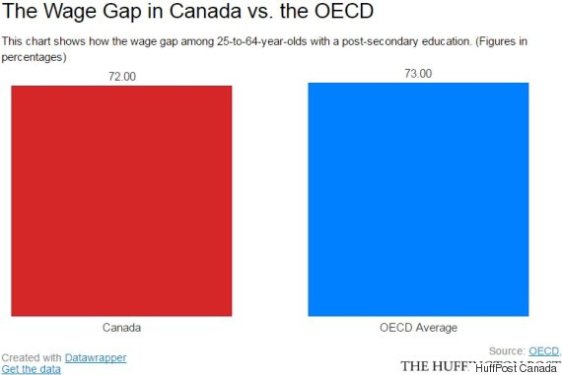
Canadian women who achieved post-secondary studies fared a bit better at 72 per cent of what men earned, which is comparable to the OECD average of 73 per cent.

wage gap

In other data, Canada had the largest share of adults with post-secondary education but a lower-than-average share of masters and doctoral degrees in 2015.

Last year, 55 per cent of Canadian adults had post-secondary education, the highest share among OECD countries compared to an average of 35 per cent.

Canada also spends more per post-secondary student than almost all of the OECD countries, at US$21,500. That places Canada sixth overall, after Luxembourg, Sweden, Switzerland, the United Kingdom and the United States.

Source: Canada’s Wage Gap Is Worse Than The OECD Average

World must ready for global microcephaly ‘epidemic’ regarding Zika virus: study

September 15, 2016

The world should prepare for a “global epidemic” of microcephaly, a condition which restricts head growth in foetuses, as the Zika virus takes root in new countries, researchers said Friday.

Scientists from Brazil and Britain said they had found additional evidence that Zika is what causes the often debilitating disorder, a link already widely accepted in medical circles.

In a study conducted among newborns in Brazil—hardest hit by a joint outbreak—nearly half of 32 infants with microcephaly had traces of Zika virus in their blood or , the team reported.

None of 62 infants born with normal heads tested positive for Zika in their blood.

This “striking association”, the researchers wrote in The Lancet Infectious Diseases journal, led them to “conclude that the microcephaly is a result of congenital Zika virus infection”.

If this is the case, “we should prepare for the epidemic of microcephaly to expand to all countries with current (local) Zika virus transmission and to those countries where transmission of the virus is likely to spread,” the team wrote.

“We recommend… that we prepare for a of microcephaly and other manifestations of congenital Zika syndrome.”

The researchers also proposed adding Zika to a category of congenital infections known to happen before or during birth. The list includes toxoplasmosis, syphilis, rubella, cytomegalovirus, HIV and herpes.

Zika is a spread mainly by mosquitoes, but in rare cases via sex.

In most people, including , it is benign with mild or no symptoms.

No cure, no vaccine

But in an outbreak that started mid-2015, it has been linked to microcephaly and rare, adult-onset neurological problems such as Guillain-Barre Syndrome (GBS), which can result in paralysis and death.

More than 1.5 million people have been infected with Zika, mainly in Brazil, and more than 1,600 babies have been born with microcephaly since last year, according to the World Health Organization (WHO).

There is no cure or vaccine.

The researchers said theirs was the first study to compare children with microcephaly to a “control” sample of healthy children—two controls for every malformed baby.

Using a control group is a way for scientists to test the impact of a single variable—in this case Zika infection—between two groups that are otherwise as similar as possible.

Eighty percent of women who gave birth to babies with microcephaly had been infected by Zika while pregnant, the team found—compared to 64 percent of mothers who delivered healthy offspring.

This meant a very high percentage of pregnant women overall had been infected in Brazil’s Zika epidemic area.

These were preliminary results, the team said, with findings on another 400-plus babies included in the study to follow later.

Interestingly, the team found that not all infants diagnosed with microcephaly had abnormalities show up in brain scans


Source: World must ready for global microcephaly ‘epidemic’: study