Andrew Phillip Chernoff

The Outer Limits To The Inner Depths

Canada’s annual inflation rate sinks to 10-month low of 1.1%, Statistics Canada Said Friday

September 25, 2016

OTTAWA: Canada’s annual inflation rate in August dipped to a 10-month low of 1.1 per cent, the seventh consecutive month it has remained below the Bank of Canada’s 2.0 per cent target, Statistics Canada said on Friday.

Analysts polled by Reuters had forecast the annual rate would edge up to 1.4 per cent from 1.3 per cent in July. The August rate was the lowest since the 1.0 per cent recorded in October 2015.

Food prices exerted the main drag on the overall rate, rising by 1.1 per cent in the 12 months to August compared to a 1.6 per cent year-on-year-increase in July. The recreation, education and reading index grew 1.1 per cent in the year to August, down from 1.9 per cent in July.

The annual core inflation rate, which strips out the prices of energy and some foods and is watched closely by the Bank of Canada, dipped to 1.8 per cent from 2.1 per cent.

The central bank, which says inflation is being influenced by temporary factors, is widely expected to keep interest rates steady until 2018.

The value of Canadian retail trade unexpectedly fell in July, dipping by 0.1 per cent from June as gas station sales dropped for the first time in four months, Statistics Canada data indicated on Friday.

Analysts in a Reuters poll had predicted sales would increase by 0.1 per cent. Statscan revised June’s data to show no change from May after initially saying sales had fallen by 0.1 per cent.

Sales decreased in five of 11 subsectors while in volume terms, sales grew by 0.3 per cent. Gas station sales fell by 3.0 per cent, pulled down by weaker pump prices.

AUTO PARTS SECTOR

Motor vehicle and parts dealers, the largest subsector, posted a 0.2 per cent drop in sales, the fourth decline in five months. Food and beverages stores, the second-largest sub-sector, saw sales edge down by 0.1 per cent.

Sales at furnishing and home furnishing stores decreased by 1.4 per cent, while sales at clothing and clothing accessories stores rose by 1.6 per cent.

Meanwhile, Canadian stocks halted a four-day rally as energy producers tumbled with crude, while inflation data that boosted the likelihood of added stimulus sent financial shares lower and an unexpected drop in retail sales weighed on consumer shares.

The S&P/TSX Composite Index fell 0.7 per cent to 14,697.93 in Toronto, paring the best weekly advance since April to 1.7 per cent. The benchmark for Canadian equity has surged 4.5 per cent in the third quarter, pushing its gain this year to 13 per cent.

Nine of the 11 sectors declined Friday, with raw-materials and energy producers losing more than 1 per cent. Oil and gas companies retreated as New York crude slumped as much as 4.1 per cent to trade at around $44 a barrel.

Financial-service firms fell 0.5 per cent on Friday. Only six of the 26 members in the group advanced. Combined the firms make up about one-third of the S&P/TSX. Bank of Nova Scotia fell 0.9 per cent after closing at a record.

Canada’s core inflation rate was the slowest in two years in August, with the pace of consumer prices and overall inflation decelerating. The data spurred bets the economy may need added monetary stimulus. That hit financial shares that would see profits crimped by lower interest rates.

Shares of consumer staples stocks fell after data showed retail sales unexpectedly fell in July. Maple Leaf Foods slumped 1.8 per cent and Loblaw Cos. slid 1 per cent to pace declines.

Raw-materials producers slipped 1.4 per cent. Barrick Gold Corporation and Goldcorp dropped more than 1.2 per cent. Silver Wheaton Corporation slumped 2.3 per cent and First Quantum Minerals fell 1.2 per cent.

Source: gulftoday.ae | Canada’s annual inflation rate sinks to 10-month low of 1.1%

Major Nova Scotia rivers dry enough to ‘walk across without getting your feet wet’

Cook’s Brook is normally an important spawning ground for salmon and trout (Stephanie vanKampen/CBC)

‘If things don’t turn around quickly, it’s going to have a lasting impact on the sport’

By Stephanie vanKampen

September 24, 2016

Nova Scotia’s severe drought has claimed another victim — the province’s recreational sport fishery is virtually non-existent, as rivers have dried up.

The head of the Nova Scotia Federation of Anglers and Hunters, Ian Avery, says the province’s 70,000 recreational fishers have nowhere to fish.

“When you go to any of the major rivers, you can literally walk across these rivers without getting your feet wet, whereas, normally you would be in knee-deep water,” said Avery.

1 in 100-year event

Avery said the drought could have a lasting impact on the brook trout and salmon fishery if rivers don’t get replenished soon.

“As the water levels drop, the temperature rises, of course, and that means a lack of oxygen for fish,” said Avery. “It’s been an anomaly this year to the point where it’s a one in 100-year event. This has never happened in Nova Scotia in quite a long time.”

Avery says the recreational sport fishery represents a $76-100 million industry in the province.

He says fishing clubs have a contingency plan to restock the rivers with small fish once water levels rise. But, he admits, that could take a while.

“If we don’t get the rain, the fish won’t be able to travel to their spawning grounds, which means less fish next year and the year after,” said Avery.

“It will have a detrimental effect on future fishing.”

On the LaHave River near Bridgewater, N.S., an area that is classified class 4-5 rapids in the spring, is now a trickle.

carroll-randall

Carroll Randall, a registered fishing guide, says what is normally a beautiful paddle on the LaHave River, is now a hike. (Stephanie vanKampen/CBC)

Carroll Randall is a registered fishing guide, but he hasn’t had any customers this summer for trout or salmon due to the drought.

He says it is hurting the fishery, but the real victims are the fish.

“We could lose a whole generation of fish,” says Randall.  “The fish have to spawn, and if they can’t find a place to spawn, then all those eggs are lost, all those baby fish are lost, and it could mean some real trouble down the road.”

Rock piles

Rivers across the province are being described as “rock piles,” with historically low water levels, according to some guides.

Randall said the federal fisheries officers who have been monitoring fish numbers in the LaHave River have reported shockingly low numbers.

Randall said just 33 fish have passed through a fish way near Morgan’s Falls. In the past, hundreds have travelled the route.

He said even recent rains haven’t put a dent in the problem. Rivers need at least 200 millimetres of rain in order to save the fish.

Source: Major N.S. rivers dry enough to ‘walk across without getting your feet wet’

Europe nears trade deal with Canada 

European Commissioner for Trade Cecilia Malmstrom at the informal meeting of EU trade ministers in Bratislava, Slovakia | Jakub Gavlak/EPA

With CETA on track, the bloc keeps TTIP on life support.

By HANS VON DER BURCHARDS

September 23, 2016

BRATISLAVA — EU ministers have forged the political momentum required to seal their long-delayed trade deal with Canada but acknowledged that a more contentious pact with the U.S. will not be finalized this year.

At a meeting in Bratislava on Friday, the ministers drew up a plan to sign up to the Comprehensive Economic and Trade Agreement with Ottawa on October 18.

This sudden acceleration toward the diplomatic finish line was only possible after German Economy Minister Sigmar Gabriel earlier in the week secured overwhelming support for CETA at a convention of his often skeptical Social Democratic Party.

The SDP vote was followed by a similarly massive majority in the Bundestag.

Europe’s accord with Canada has become a defining test of whether Brussels is still able to steer the EU’s trade policy and the pact seemed in mortal danger while Germany’s commitment remained in question.

In Bratislava, Gabriel said he was now “very optimistic” that all 28 countries should be able to throw their weight behind the pact after months of tortuous diplomacy.

In addition to concerns in Germany, CETA’s advocates have needed to confront objections from Romania over visa reciprocity and Belgium’s Wallonia region about the rights of foreign investors to sue governments.

The most significant remaining hurdle, however, is Austria, where Social Democratic Chancellor Christian Kern has struck an increasingly hostile tone towards free trade.

Many diplomats, however, predicted that Vienna would ultimately sign on October 18, not least because of pressure from Berlin.

Source: Europe nears trade deal with Canada – POLITICO

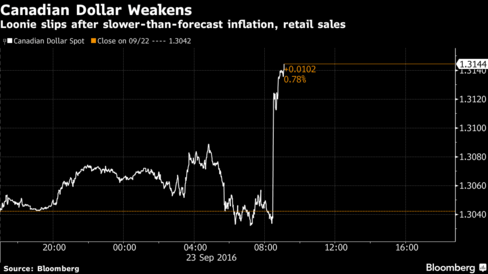
Loonie Weakens as Inflation Data Raise Chance for Bank Of Canada Rate Cut

By Maciej Onoszko

September 23, 2016

  • Currency is on track for a quarterly loss, its first in 2016
  • Probability of monetary easing this year rises to 18 percent

Oil sands surplus jamming up pipelines to U.S. 

Bloomberg News

Source: Oil sands surplus jamming up pipelines to U.S. – The Globe and Mail